Friday, July 17, 2020

One Long River of Song: Notes on Wonder by Brian Doyle


During this pandemic, I have not felt up to reading anything new. I have only been rereading two series of mysteries, one by Louise Penny and the other by Faye Kellerman. However, we just got back from a trip to Lynden, WA, and the first day there, I met my sister in Village Books, a wonderful bookstore in downtown Lynden. I saw this book, One Long River of Song: Notes on Wonder by Brian Doyle, and remembered I had heard other authors speak glowingly of Brian Doyle, so I bought it.

It is one of the best books I've ever read! The book is a collection of Doyle's essays. Some are only a page or page and a half long, some are several pages. I devoured every one of them. Then I reread them. Then I read them aloud to my husband and daughter. Then I went on Amazon and put every book he wrote into my shopping cart, but went through and marked some "Save for later" because it was too much. I'm trying to limit the number of books in my library, but I keep discovering amazing authors, and I want them around me.

In the foreword, David James Duncan quotes Pico Iyer, who said:
Almost nobody has written with the joy, the galloping energy, the quiet love of conscience and family and what's best in us, the living optimism.
"Galloping energy" is right. Many times I pictured the words in his sentences galloping and crowding and bumping into each other like beagles running and tripping over their long ears, full of joy, breathless to say what is tumbling out of his mind.

Here is an example from an essay named "Illuminos," about his 3 children (a daughter and twin boys).
The third child held hands happily all the time, either hand, any hand, my hands, his mother's hands, his brother's hands, his sister's hands, his friends, aunts and uncles and cousins and grandparents and teachers, dogs and trees, neighbors and bushes, he would hold hands with any living creature whatsoever, without the slightest trepidation or self-consciousness, and to this day I admire that boy's open genuine eager unadorned verve. He once held hands with his best friend during an entire soccer game when they were five years old, the two of them running in tandem, or one starting in one direction unbeknownst to the other and down they both went giggling in the sprawl of the grass. It seems to me that angels and bodhisattvas are everywhere available for consultation if only we can see them clear; they are unadorned, and joyous, and patient, and radiant, and luminous, and not disguised or hidden or filtered in any way whatsoever, so that if you see them clearly, which happens occasionally even to the most blinkered and frightened of us, you realize immediately who they are, beings of great and humble illumination dressed in the skins of new and dewy beings, and you realize, with a catch in your throat, that they are your teachers, and they are agents of an unimaginable love, and they are your cousins and companions in awe, and they are miracles and prayers and songs of inexplicable beauty whom no one can explain and no one own or claim or trammel, and that simply to perceive them is to be blessed beyond the reach of language, and that to be the one appointed to tow them along a beach, or a crowd, or home through the brilliant morning from the muddy hilarious peewee soccer game is to be graced beyond measure or understanding; which is what I was, and I am, and I will be, until the day I die, and change form from this one to another, in ways miraculous and mysterious, never to be plumbed by the mind or measures of man.
(By the way, did you wonder, as I did, what "bodhisattvas" are? According to the interwebs, they are: In Mahayana Buddhism, a person who is able to reach nirvana but delays doing so out of compassion in order to save suffering beings. That made me laugh, to think of little kids being persons who could reach nirvana but were sticking around to help the rest of us.)

Our modern poet-saint, Mary Oliver, said of Brian Doyle's essays, "They were all favorites." True! It makes it hard to write or talk about this book and say why I like it. It makes it hard to decide what to write as an example or read out loud to someone. How can I choose?! Some crack you up, some choke you up, some make you stop, reread and ponder, some make you feel what awe feels like. The subtitle is "Notes on Wonder." I think wonder includes all of these -- the laughter, the tears, the pause, the awe.

One of the essays that cracked me up is named "20 Things the Dog Ate." I wish I could quote all 20 for you, but I have chosen two.
1. Ancient Squashed Dried Round of Flat Shard of Beaver
Sweet mother of the mewling baby Jesus! You wouldn't think a creature that likes to watch Peter O'Toole movies would be such an omnivorous gobbling machine, but he has eaten everything from wasps to the back half of a raccoon. And let us not ignore the beaver. Speculation is that beaver was washed up onto road when overflowing lake blew its dam, was squashed by a truck, got flattened ten thousand times more, then summer dried it out hard and flat as a manhole cover, and the dog somehow pried it up, leaving only beaver oil on the road, and ate it. Sure, he barfed later. Wouldn't you?
4. Yellow Jacket Wasps
Every summer. Even though he gets stung again and again in the nether reaches of his mouth and throat and jumps up whirling around in such a manner that we laugh so hard we have to pee. He cannot resist snapping them out of the air as if they were bright bits of candy, then making high plaintive sounds like a country singer on laughing gas. I have to pee.
I could go on and on. My heart and soul have been lifted by this book. It's become trite to say that something is perfect "for these strange times we are in." Still, I do think this book is a good one for this coronatide, with the pandemic on top of the huge reckoning we are going through regarding our racial relations. This book touches you and takes you deep, but it's a pick-up-and-put-down-er-of-a-book. The essays are short, so it's easy to read one or two and come back to it later.

I am so sorry that I never got to see or hear Brian Doyle in person. He died in 2016 of complications from a brain tumor. He was a devout Catholic who also, according to his friend David James Duncan, "sometimes audaciously, challenged his tradition." Like the Jesuits teach, and my Reformed doctrine emphasizes, he personifies seeing God in everything, recognizing that "there is not a square inch in the whole domain of our human existence over which Christ, who is Sovereign over all, does not cry: 'Mine! '" (Abraham Kuyper). But there is not even a tiny echo of preaching. He hardly mentions the word God (although there is one essay called "God Again," where he writes about a US Post Office clerk, "God was manning the counter from one to five, as he does every blessed day. He actually says every blessed day and he means it. You never saw a more patient being.")

I have read often that many of us are in a meaning crisis, unable to figure out a purpose in life. I will end with an excerpt from "The Final Frontier." May we all reach it - "humility, the final frontier."
Of course you do your absolute best to find and hone and wield your divine gifts against the dark. You do your best to reach out tenderly to touch and elevate as many people as you can reach. You bring your naked love and defiant courage and salty grace to bear as much as you can, with all the attentiveness and humor you can muster. This life after all a miracle and we ought to pay fierce attention every moment, as much as possible.
But you can not control anything. You cannot order or command everything. You cannot fix and repair everything. You cannot protect your children from pain and loss and tragedy and illness. You cannot be sure you will always be married, let alone happily married. You cannot be sure you will always be employed, or healthy, or relatively sane.
All you can do is face the world with quiet grace and hope you make a sliver of difference. Humility does not mean self-abnegation, lassitude, detachment; it’s more calm recognition that you must trust in that which does not make sense, that which is unreasonable, illogical, silly, ridiculous, crazy by the measure of most of our culture. You must trust the you being the best possible you matters somehow. That trying to be an honest and tender parent will echo for centuries through your tribe. That doing your chosen work with creativity and diligence will shiver people far beyond your ken. That being an attentive and generous friend and citizen will prevent a thread or two of the social fabric from unraveling. And you must do all of this with the certain knowledge that you will never get proper credit for it, and in fact the vast majority of things you do right will go utterly unremarked. Humility, the final frontier, as my brother Kevin used to say. When we are young we build a self, a persona, a story in which to reside, or several selves in succession, or several at once, sometimes; when we are older we take on other roles and personas, other masks and duties; and you and I both know men and women who become trapped in the selves they worked so hard to build, so desperately imprisoned that sometimes they smash their lives simply to escape who they no longer wish to be; but finally, I think, if we are lucky, if we read the book of pain and loss with humility, we realize that we are all broken and small and brief, that none amongst us is ultimately more vulnerable or rich or famous or beautiful that another; and then, perhaps, we begin to understand something deep and true about humility.
That is what I know: that the small is huge, that the tiny is vast, that pain is part and parcel of the gift of joy, and that this is love, and then there is everything else. You either walk toward love or away from it with every breath you draw. Humility is the road to love. Humility, maybe, is love. That could be. I wouldn’t know; I’m a muddle and a conundrum shuffling slowly along the road, gaping in wonder, trying to see and say what is, trying to leave shreds and shards of ego along the road like wisps of litter and chaff.
 "All you can do is face the world with quiet grace and hope you make a sliver of difference." As Brian would say, And so: Amen.

Thursday, July 16, 2020

World, where does it hurt?


I read the last part of this poem to my church on the Sunday after 9/11. It feels pretty appropriate now, too.

i held an atlas in my lap
ran my fingers across the whole world
and whispered
where does it hurt?
it answered
everywhere
everywhere
everywhere.


what they did yesterday afternoon
– Warsan Shire

they set my aunts house on fire
i cried the way women on tv do
folding at the middle
like a five pound note.
i called the boy who used to love me
tried to ‘okay’ my voice
i said hello
he said warsan, what’s wrong, what’s happened?
i’ve been praying,
and these are what my prayers look like;
dear god
i come from two countries
one is thirsty
the other is on fire
both need water.

later that night
i held an atlas in my lap
ran my fingers across the whole world
and whispered
where does it hurt?
it answered
everywhere
everywhere
everywhere.

Thursday, June 25, 2020

Some resources on racism


With all the focus on racism, there are many discussions and resources being published about racism and white supremacy. These are a few that have been helpful to me.

Wilhelm Verwoerd on The Confessional podcast. This one really struck home to me. Wilhelm Verwoerd is a South African whose grandfather was the prime minister during apartheid. He grew up in the Dutch Reformed Church, which is a "sister church" of my denomination, the Christian Reformed Church in North America. Of course, we in the US do not have apartheid and all the violence

Hearing Wilhelm speak with his South African/Dutch accent struck a chord of familiarity. My denomination has many Dutch immigrants in it and my own local church has a family that came from South Africa as well as several 1st generation Dutch immigrants. That accent is both familiar and beloved to me.

At one point he talks about the way anti-communism played into their beliefs and actions:
...we were also very much influenced by the Cold War anti-communist rhetoric. So in these church gatherings and when we would go out and do things, we would also be very conscious of preaching anti-communism because people were saying that the African National Congress, you know, former President Mandela’s political party, they were really not liberation fighters. They were terrorists. You know, they were communist-inspired terrorists...
This also resonated with me, as I hear people talking about Black Lives Matter being Marxist. 

It sounds as if Wilhelm has stayed in the church and kept his faith. I know Nadia has as well. I am glad of that. I also liked what he said about not being overwhelmed by guilt -- and that his fellow South Africans who are black tell him not to:
We’re not asking you to reject the color of your skin. You cannot. Even your culture, we’re not asking you to turn into some kind of gray nobody South African. That’s not what we are against. What we’re against is what those policies stand for and what they did to us. And we’re asking you to become part of changing that. Use who you are to become part of the liberation of all of us. And that invitation was the critical moment to say, yes, there is this painful truth, but I don’t have to go and hide in a corner. I don’t have to be overwhelmed by the sense of guilt and shame.
His reference to the Black Christ painting by Ronald Harrison is moving and remarkable. You can see why he says that when South Africans see his skin color (white), hear his accent, and then his surname--the name of his grandfather who was prime minister--, it brings a lot into the room before he even opens his mouth. In the painting, the model for the Black Christ was an African National Congress president, and the centurion piercing Christ's side is Wilhelm's grandfather.

from Business & Arts South Africa, "Ronald Harrison Paintings at Luthuli Museum."


Krista Tippett: Mindfulness in Uncertain Times, Commonwealth. I watched this live and my question was the first one they read during the Q & A!

A Conversation with Lorna Goodison, Padraig O'Tuama, Image Journal.

'I Cannot Sell You This Painting.' Artist Titus Kaphar on his George Floyd TIME Cover


A Facebook post by Mike Van Denend, previous Director of Alumni at Calvin University:

It certainly has been a week--of shock, of sorrow, of anger, of confusion. Many of you have written passionate words and passed on thoughtful articles. My Facebook Universe is a diverse lot, from all corners of the globe, faiths and the political spectrum. Thank you for educating me.

I think best on long bike rides in God's amazing creation, and today these reflections came as I think about what's happened since George Floyd's horrific death in Minneapolis.

1. Tragedy and Grief. George Floyd was a child of God. It doesn't matter what his life was like before he was killed. Jesus knew his name and he was a sinner saved by grace, like you, like me. So if you begin by reciting Mr. Floyd's past, you've already tipped your hand. It doesn't matter. No one deserves to die in such an awful manner. No one.

2. Black Lives Matter NOW. The African-American community is in particular grief at this moment and to sorrow and console and demand better with them is right and just. This does not mean that other lives matter less or do not matter. That's a pointless diversion. Hopefully, you don't go to a funeral home and bend the ear of the grieving widow about your pain and loss. Right now, at this time, our black brothers and sisters need assurance, consolation and some hope for change.

3. Internalization. And why might #2 be so true? I owe a lot to a piece written recently by Radley Balko and to the stories from African-American friends. White people can view the ghastly video of Mr. Floyd's death and be shocked, but perhaps not psychologically seared; they can compartmentalize the death. Most black people cannot do so--it is internalized. "That could be me or a loved one," is a much more a likely response. They can visualize this actually happening to someone close. A very big difference and it produces a very big grief.

4. History. Since racism is burned deeply into the American story, there's every reason for persons of color to worry about an awful manifestation of this sin harming them in some way. And there's a weariness here. It's been going on for a long, long time. Pick your date: 1965, 1865, 1619, whichever. When I hear someone tell me of the "progress" that's been made, the death of Mr. Floyd underscores that the steps forward are only the start of a long march to justice. The film of Bryan Stevenson's stellar book "Just Mercy" is streaming for free now. Watch it.

5. Power and Responsibility. Police officers have a challenging job and many do their work well. But if you are given power (badge, gun, law behind you), you have ten-fold the responsibility not to abuse your power. Same for pastors, politicians, judges--anyone who takes a pledge or oath of office. That's what makes this death all the more heinous. This was not the same as "black-on-black" or any other kind of crime category you want to set up as a false equivalent. This kind of violence is abhorrent; violent behavior from a person expected to act in the public trust adds another layer of condemnation.

6. Take Specific Action! President Obama suggested that every Mayor of every American city should seize this moment and review their use-of-force protocols. That's a good place to start. Every Mayor: That means the Mayors of Grand Rapids, Holland and Kalamazoo as well as the Mayors of Minneapolis and Chicago and other big cities. Yes, even the Mayor of Small Town, USA. And while we're at it, let's review the way these violent cases are handled by the police, unions, cities and officials. Eight minutes and 46 seconds. That is a long time to be pressing your knee into someone else's neck. Why do you think the officer thought he could do such a thing and not worry about the consequences? Because, without the video, there wouldn't have been any.

7. Violence in the Protests. Violence against anyone is wrong and wanton destruction and looting is obviously a crime. No argument. It is interesting to note that where police, sheriffs and other officials make a real effort at listening and showing empathy, this kind of behavior is diffused.

8. Compassion. Up to today, my only post on Mr. Floyd's tragic death was a quote about compassion. I still think that's a very important first step. If compassion is "the capacity to feel what it's like to live inside someone else's skin," let that be our personal challenge, especially skin that's a different color than our own.

We must enter the Kingdom of God through much sorrow.

A beautiful reflection by Jeff Chu on "Wir müssen durch viel Trübsal in das Reich Gottes eingehen," which translates to "We must enter the Kingdom of God through much sorrow."
https://jeffchu.substack.com/p/we-must-go-through-many-troubles

The reflection includes a link to the cantata sung by the Netherlands Bach Society.

I also found a translation of the words, and have included that in the text below.

We Must Go Through Many Troubles

Some fragmented thoughts on a Bach cantata.

The 24th Day after Coronatide*
Grand Rapids, Michigan
Greetings, friend.
It might seem strange that I tell you, at the top of every letter, that I’m writing from Grand Rapids, Michigan. I’m always writing from Grand Rapids, Michigan. It’s partly a pretentious thing: I love those old letters, scrawled in ink, where the writer tells you she’s writing from Bergamo or Constantinople or the Argentine. It’s also partly hope. One day, I will write you a letter from somewhere other than Grand Rapids, Michigan, because we will be able to travel again.
I need that vain hope right now. It’s been a tough couple of weeks, and maybe I’ll write another time about precisely why. For now, though: I was thinking the other day about Bach and a cantata I heard a few years ago. (Yes, I’m a weirdo. I’d say caveat lector, but it’s too late for that. You already knew I was strange from the previous paragraph, many of you knew even before, and still, you kept reading.)
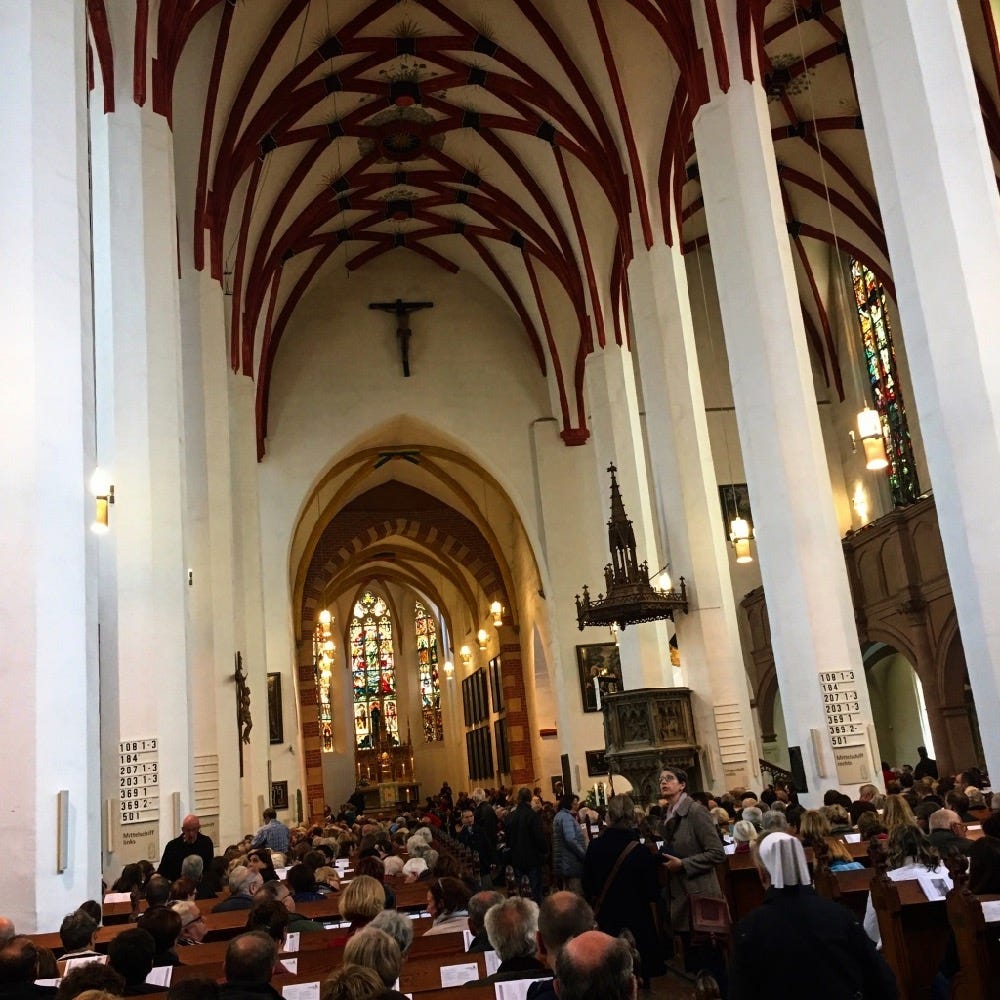
Three springs ago, when we could still travel, I went to Leipzig, Germany, on assignment for Travel+Leisure magazine. The story’s marching orders had something to do with hipsters and visual artists and low rents and edgy neighborhoods. (You can read the story here.) Shockingly, my editors didn’t particularly care that it was the 500th anniversary of the Protestant Reformation. Nor were they all that interested in what I really wanted to do in Leipzig: I wanted to hear Bach.
The Saturday-afternoon motet at the Thomaskirche is one of the world’s great bargains: two euros for a 75-minute performance that usually features both the Thomanerchor, the famed boys’ choir that has been singing for eight centuries, and a small ensemble of the Gewandhaus, one of the world’s oldest and best orchestras. When I asked an usher whether I was in the right place for the Bach concert, he stiffened and hissed a five-word rebuke: “It is a worship service.” 
The service took place in the same 15th-century Gothic church in which Bach, as kapellmeister for 27 years, had come alongside the congregation musically Sunday after Sunday. He wrote for this space—or maybe it’s better to say for the people of God gathered in this space. I wonder: How did those worshippers hear it? Though we treasure Bach’s music, it bears remembering that prominent critics of his day described his work as “turgid,” “artificial,” and “confused in its style.”
The Thomaskirche just before the concert that was not a concert
The service that day began with a movement of a Mendelssohn organ sonata and a sweet choral motet by the 17th century composer Heinrich Schütz (I’d never heard of him) based on the “true vine” metaphor from John’s Gospel. But I was really there for the Bach.
Like many obedient Chinese American kids, I grew up taking music lessons—in my case, 13 years of piano, 12 of violin, and three of viola. Bach was core to my musical education. On the piano, there were the two-part inventions; on the violin, minuets, gavottes, a bourrée, and the Bach Double—his Concerto in D minor for two violins, which every Suzuki kid who endured through Book Four had to learn. To this day, anytime I hear the Bach Double’s first six notes, my left hand automatically starts twitching the fingerings for that quick upward sprint from the open D string.
I don’t play music much anymore. When I went to college, I shelved my violin; I didn’t think I was good enough to sit alongside kids who had been much more diligent about practicing. Once in a while, if I’m at my parents’ house or maybe in a church sanctuary when nobody else is around, I might be brave enough to sit at the piano and plunk something out. Deep within me, I know the music isn’t done. 
It’s remarkable how, through his compositions, Bach could preach. Even now, it only takes a few bars of Jesu, Joy of Man’s Desiring for me to feel enfolded in the strings’ gentle, lilting embrace, an orchestral representation of Christ’s love for humanity. 
At the Thomaskirche that day, the main cantata was Wir müssen durch viel Trübsal. (You can listen to the whole thing, sung by the Netherlands Bach Society.) The cantata’s first lines draw on Acts 14, which recounts the travels of Paul and Barnabas through Asia Minor. According to verse 22, after reaching Antioch, “they strengthened the disciples and urged them to remain firm in the faith. They told them, ‘If we are to enter God’s kingdom, we must go through many troubles.’”
Scripture reminds us that there’s nothing new under the sun, which might explain why some of us can find resonance in Bach’s 300-year-old compositions. None of this is to suggest that I unreservedly venerate Bach, a flawed person (yes, redundant phrasing) and a man of his times; that would be unfaithful to my Reformed view of humanity. Rather, this is about some music he left behind. I read Acts 14:22 and hear Bach’s interpretation of it as descriptive, not prescriptive. Trial and tribulation aren’t inherently redemptive, nor are suffering and persecution badges of honor; they’re realities of life in this world. They’re also not the end of our story.
Bach wrote from personal knowledge of such troubles. Though he was born into an ostensible peace more than three decades after the end of the Thirty Years’ War, it took generations for the resulting economic distress to heal, and some might argue that we’re still living the legacy of the religious wars. Christianity might have begun as a religion with an unusually wide welcome for its time, but we’ve shown again and again just how easy it is to slip into the role of spiritual bouncer—and how hard it is to say, wholeheartedly, “Welcome.” 
Bach also lived amidst a pandemic that refused a tidy end. Numerous Bach cousins succumbed to the plague, and Bach himself was orphaned at the age of 10. His sorrows continued into his adulthood. He was widowed at 35, becoming a single father to four. (Three other children had died in infancy.) After he remarried, he and his second wife had 13 more kids; only six survived childhood.
Bach’s career, too, was full of frustration. One of the only extant pieces of Bach’s correspondence records him complaining that he wasn’t making enough money to provide for his family. I also wonder whether he ever forgot that he wasn’t the first choice for the prestigious job of kapellmeister; Telemann was. He wasn’t the second or third choice either; Graupner and Fasch were. (Remember them?!) Upon hiring Bach, one Leipzig councilman said: “Since we cannot get the best, then we will have to settle for average.” (God help me to achieve someday the same level of average that Bach did.) 
The cantata’s fourth movement, a soprano recitative, especially resonates in our times:
Lord! Take note, look here,
They hate me, and have no guilt,
as if the world had the power
even to kill me;
and I live with sighs and patience
abandoned and despised,
so at my suffering they have
the greatest joy.
My God, that is difficult for me.
But Bach does not leave us abandoned and despised or wallowing in despair. By the eighth movement, we have moved to hope.
Be so joyous, o my soul,
And forget all stress and anguish,
since now Christ, your Lord,
calls you out of this valley of sorrow.
This movement’s intent is lost if you choose to listen to any one section of the cantata in isolation. This piece was meant to be journeyed through in its entirety, in worship. And I don’t believe Bach intended for his music mainly to entertain, though it could be entertaining, or to gratify, though it could be gratifying. He meant it to move, to shift, to propel. 
Bach had a copy of the Calov Bible, a three-volume edition that included commentary by both Martin Luther and the 17th-century Lutheran theologian Abraham Calov. (Bach’s copy is now held in the collection of the Concordia University Library in St. Louis, Missouri.) On the margins of the text—what wisdom can so often be found on the margins—Bach scribbled some of the only nonmusical clues we have about his personal faith. Next to 2 Chronicles 5, he wrote, “Where there is devotional music, God with his grace is always present.”
I want that to be true. And during that service, as I regarded the sanctuary from my back pew, I saw how moved people were. It’s impossible to know their stories: Had they come for a concert like I had, or were they feeling the tug of worship on a sunny Saturday afternoon? However they arrived there, as the choir sang and the orchestra played, I saw an old man in a pew near mine, tears dampening his cheeks. A middle-aged couple sat not far away, their hands interlaced, her head on his shoulder. A pair of stereotypically hipster twenty-something guys, dressed as if ready for the transcendent techno of one of Leipzig’s famed nightclubs, gazed intently at the ribbed ceiling.
At one point, everyone stood, German speakers first, so I stood with them, because if growing up in church teaches you anything, it’s how to follow a crowd. It became clear after the first words—“Vater unser...”—what was up: the Lord’s Prayer. And whatever the empirical data might show about Europe’s post-Christian existence, the anecdotal data was that these folks, young and old, German and non, knew the words. In German and English, Italian and French and Spanish, a gorgeous chorus rose throughout the congregation. Whether they believed in their hearts, I can’t tell you, but they did speak this ancient prayer with their mouths, and sometimes, we say and we pray what we’re not sure what we believe, maybe because we want to hope that some of the words are true.
I recalled the usher’s corrective: It is a worship service. I’d come for a concert; what the usher, the pastor, and Bach had offered instead was an invitation. This wasn’t for consumption; it was for participation. That’s what the best sacred music does, whether it’s a modern praise song or an old spiritual or the soundtrack of the Beyoncé Mass. Especially when we’re struggling to hold onto hope, it can point us to something beyond ourselves, remind us of a body—and bodies—beyond our own, and tell a story that’s not only grander than ours but also encompasses us.
Translation:
Cantata for Jubilate
1. Sinfonia

2. Chor

Wir müssen durch viel Trübsal in das Reich Gottes eingehen.
(Acts 14:22)
1. Sinfonia

2. Chorus

We must enter the Kingdom of God through much sorrow.
3. Arie A
Ich will nach dem Himmel zu,
Schnödes Sodom, ich und du
Sind nunmehr geschieden.
  Meines Bleibens ist nicht hier,
  Denn ich lebe doch bei dir
  Nimmermehr in Frieden.
3. Aria A
I want to go to heaven;
contemptible Sodom, you and I
are parted from now on.
  My resting-place is not here,
  since I can live with you
  nevermore in peace.
4. Rezitativ S
Ach! wer doch schon im Himmel wär!
Wie dränget mich nicht die böse Welt!
Mit Weinen steh ich auf,
Mit Weinen leg ich mich zu Bette,
Wie trüglich wird mir nachgestellt!
Herr! merke, schaue drauf,
Sie hassen mich, und ohne Schuld,
Als wenn die Welt die Macht,
Mich gar zu töten hätte;
Und leb ich denn mit Seufzen und Geduld
Verlassen und veracht',
So hat sie noch an meinem Leide
Die größte Freude.
Mein Gott, das fällt mir schwer.
Ach! wenn ich doch,
Mein Jesu, heute noch
Bei dir im Himmel wär!
4. Recitative S
Ah! if I were only in heaven!
In what way am I not oppressed by the evil world!
I awake in tears,
in tears I lay down in my bed,
how deceitfully am I assailed!
Lord! Take note, look here,
they hate me, though guiltless,
as if the world had the power
even to put me to death;
while I live with sighs and patience
abandoned and scorned,
even at my suffering they have
the greatest joy.
My God, this lays heavily upon me.
Alas! if only,
my Jesus, even today
I were with You in heaven!
5. Arie S
Ich säe meine Zähren
Mit bangem Herzen aus.
Jedoch mein Herzeleid
Wird mir die Herrlichkeit
Am Tage der seligen Ernte gebären.
5. Aria S
I sow my tears
with an anxious heart.
However my heart's sorrow
will become glory for me
on the day the blessed sheaves are harvested.
6. Rezitativ T
Ich bin bereit,
Mein Kreuz geduldig zu ertragen;
Ich weiß, daß alle meine Plagen
Nicht wert der Herrlichkeit,
Die Gott an den erwählten Scharen
Und auch an mir wird offenbaren.
Jetzt wein ich, da das Weltgetümmel
Bei meinem Jammer fröhlich scheint.
Bald kommt die Zeit,
Da sich mein Herz erfreut,
Und da die Welt einst ohne Tröster weint.
Wer mit dem Feinde ringt und schlägt,
Dem wird die Krone beigelegt;
Denn Gott trägt keinen nicht mit Händen in dem Himmel.
6. Recitative T
I am ready
to bear my Cross patiently;
I know that all my troubles
are not equal to the glory
that God will reveal to the chosen flock
and even to me.
Now I weep, since the turmoil of the world
seems joyful next to my suffering.
Soon the time will come
when my heart will rejoice,
and when the world one day will weep without comfort.
Whoever strives and battles with the enemy,
will have the crown placed upon him;
for God carries no one to heaven in His hands.
7. Arie (Duett) T B
Wie will ich mich freuen, wie will ich mich laben,
Wenn alle vergängliche Trübsal vorbei!
  Da glänz ich wie Sterne und leuchte wie   Sonne,
  Da störet die himmlische selige Wonne
  Kein Trauern, Heulen und Geschrei.
7. Aria (Duet) T B
How I will rejoice, how I will delight,
when all mortal sorrows are over!
  There I will shine like a star and glow like the   sun,
  then the divine, blessed joy will be destroyed
  by no sorrow, moan or shriek.
8. Choral
Freu dich sehr, o meine Seele,
Und vergiß all Not und Qual,
Weil dich nun Christus, dein Herre,
Ruft aus diesem Jammertal!
Aus Trübsal und großem Leid
sollst du fahren in die Freud
die kein Ohre hat gehöret
und in Ewigkeit auch währt.
8. Chorale
Rejoice greatly, o my soul,
and forget all stress and anguish,
since now Christ, your Lord,
calls you out of this valley of sorrow!
Out of trouble and great distress
you shall journey into such joy
that no ear has ever heard,
and that lasts throughout eternity.
Acts 14:22 (mov't. 2); "Freu dich sehr, o meine Seele," last verse: Freiburg 1620 (mov't. 8)
©Pamela Dellal

Sunday, June 14, 2020

Sunday, June 07, 2020

"I need help with me."

posted on Facebook by Anne Lamott.

The only thing awake besides me was my disease of self-loathing, which is always sitting nicely at the foot of my bed waiting for me to wake up so it can begin the litany of what a disappointment I am, ways to hide this from the world, and while we’re at it, how behind I already am on the day.

But then I remembered that one other thing was awake, what people in the recovery community call my higher power. My higher power sometimes looks like a dark-skinned Middle Eastern Jew, and sometimes like Bette Midler. So I turned to the two of them and said the great prayer: Help.

Our pastor’s sister died last night, and so she won’t be preaching today. Our tiny church of 30 is in collective mourning for both of them, although none of us had ever met the sister. Here on this side of eternity, we are asked to survive unsurvivable loss, and times of wailing, gnashing of teeth, heartbreak. It’s not a good system. If I was God’s West Coast representative, a job for which I am uniquely suited, I would have created an easier way through life, a way that made more sense and didn’t hurt as much. As things are now—nationally, globally, in my circle, and because of my behavior—I needed her sermon more than ever. I am consumed with the need for spiritual medicine.

But the horrible truth is that if we want the healing, we start with the revealing. Thus every so often one gets to see what a total asshat one is, beneath the charming and witty persona. It’s a necessary nightmare on the path to Union with all that is good, or that is at least somewhat better.

I got to see this half an hour ago.

When I hear people use the word intimacy as into-me-I-see, I resist, but then, because the willingness to change comes from the pain of not changing, I eventually take a peek. Eeeeesh! Ick. Marbled into my basic decency and good-heartedness, I see the rats and worms under my psyche’s woodpile. I see my narcissism, my racism. I see my inner Glengarry Glen Ross—I want to at least win the set of steak knives!—and that I would be pushing older people out of the way to get the last seat in the lifeboat.
They are going to die soon anyway, and I’m a young 66.

Half an hour ago, I got to see what a snarky jerk I can be. I did something hurtful to a friendly and innocent person. In my defense, I felt like I was just hanging on yesterday, after witnessing the brutality of last week, the devastation of the last three months, the fever dream of the last four years. I had been in tears, I had been sick with fear, I had been blindsided by a sheet metal sense of isolation. I was a mess.

That’s my excuse and I am sticking to it.

Except that this is not good enough if transformation is going to come out of all that we have been going through. This will include both the deep dive into miserable truths and radical self-forgiveness. Neither is my strong suit.

Half an hour ago, a man I am working with sent me an email that I had written about him, in my snarkiest voice, that I’d meant to send to someone we are both working with. I had accidentally sent it to him. It was me at my most cutting and sophomoric, definitely not my loveliest side.

It was 6:00 a.m. when I read the man’s note that I had sent the email to him. I felt stunned with awfulness. I tried to pray, but it was not as a supplicant; I just wanted to feel better. It was like Flip Wilson saying, “I’m gonna pray now—anyone need anything?” I didn’t even know what I needed.

Everyone who might help me was asleep, especially the husband, who might have helped me see that we all screw up right and left. It comes with the territory. He would have said that the next right actions were to feel my scary feelings, make amends to the man, and then set about forgiving myself again. But he slept soundly beside me. Even the old dog, whose love and loyalty are probably the closest I am going to come to experiencing divine love on this side of eternity, slept soundly, emitting her strange sleeping sounds and hints of digestive distress.

That’s all. Simple: I’m stuck, help me. Jesus always reminds me that I am crazily loved and forgiven, no matter what I do or think, and while I often only half believe this, it helped. And Bette reminds me that we are all in this together, through the tears, fears and joy; we stick together, laughing and crying, and this turns out to be enough.

In the absolute silence and stillness of the early morning, they came to me, pulled me to my feet, and dusted me off. I made myself coffee, fed the dog, wrote a heartfelt and contrite email to the man, and asked for his forgiveness. I knew he’d forgive me because he is a good guy, but me? That’s the hardest work I do, and I can’t do it by myself.

As the old riddle goes, What’s the difference between me and God? the answer is, God never thinks He’s me.

I need so much help. I hate this! I like to be a helper, the girl valued as the flight attendant to her damaged family.

When my son was five or six, we were visiting my friends in the city, when all of a sudden we heard a tiny distressed voice. We turned toward the sound. Sam had managed to get his head stuck in the slats of a chair he had been clamoring on.

He stared at us like a dwarf in the stocks of Salem. He said, “I need help with me.”

I live by these words. The two friends had his words calligraphied and framed for us. I have it on the wall of my office. I need help with me.

Half an hour ago, I breathed this in. I need help. We all do and it is how it should be. My pastor will need all hands on deck to help her bear the loss of her sister. My country will need millions of people joining together for justice and reconciliation. We need help with us. It is the prayer of the miserable and scared and very stuck, who still against all odds believe that we can be changed and freed.

It is my prayer for us now.


Sunday, May 31, 2020

Into Three Pines by Mavis Moon

Map of Three Pines, Inspector Gamache mysteries by Louise Penny. https://www.louisepenny.com/

I propped up the pillows and got into bed.
The sunlight poured through the panes.
I opened my book, lit by the light,
and entered Three Pines in Quebec.
I chose a table at the bistro.
Olivier's latte and almond croissant.
My body filled with contentment and sweetness.

I read this article about writing a lyric poem and thought I would try it.

Possibilities by Wisława Szymborska


Amanda Palmer Reads Polish Nobel Laureate Wisława Szymborska’s Glorious Poem “Possibilities”

I prefer movies.

I prefer cats.

I prefer the oaks along the Warta.

I prefer Dickens to Dostoyevsky.

I prefer myself liking people

to myself loving mankind.

I prefer keeping a needle and thread on hand, just in case.

I prefer the color green.

I prefer not to maintain

that reason is to blame for everything.

I prefer exceptions.

I prefer to leave early.

I prefer talking to doctors about something else.

I prefer the old fine-lined illustrations.

I prefer the absurdity of writing poems

to the absurdity of not writing poems.

I prefer, where love’s concerned, nonspecific anniversaries

that can be celebrated every day.

I prefer moralists

who promise me nothing.

I prefer cunning kindness to the over-trustful kind.

I prefer the earth in civvies.

I prefer conquered to conquering countries.

I prefer having some reservations.

I prefer the hell of chaos to the hell of order.

I prefer Grimms’ fairy tales to the newspapers’ front pages.

I prefer leaves without flowers to flowers without leaves.

I prefer dogs with uncropped tails.

I prefer light eyes, since mine are dark.

I prefer desk drawers.

I prefer many things that I haven’t mentioned here

to many things I’ve also left unsaid.

I prefer zeroes on the loose

to those lined up behind a cipher.

I prefer the time of insects to the time of stars.

I prefer to knock on wood.

I prefer not to ask how much longer and when.

I prefer keeping in mind even the possibility

that existence has its own reason for being.

The pain inside us and right in front of us in nothing compared to the power of love that surrounds us. --Anne Lamott


A Facebook post from Anne Lamott, May 31, 2020, 7 days after the killing of George Floyd, during the pandemic, while riots are happening.

I wish I had my Sunday School kids today, during the devastation of the pandemic and the terrifying images of murder and protest. I would tell that I am lost, too, but from the wise old pinnacle of my years, I would assure them that we can trust God no matter how things look and how long things take. The pain inside us and right in front of us in nothing compared to the power of love that surrounds us.

Also, I would rustle the bag of chips at them, so they will listen awhile. Then I put the chips away and ask each child their name. Names matter! Names are our deepest truth and beauty. Their name is Beloved.

This goes quickly as there are usually only three or four kids, of different colors and ages. My only message most Sundays is that they are loved exactly as they are, whatever they have done, whoever they love. As is!

I’d ask them what isolation has been like for them, and if they are okay, and what they make of the fires on TV. I would listen to their pain and anger, share my exhaustion with it all, and remind them of what John Lennon said, that “Everything will be okay in the end. If it’s not okay, it’s not the end.” I ask if they believe that to be true. They shrug: sort of.

I would remind them of what Martin said, that the moral arc of the universe is long, but it bends towards justice. Even now, in the chaos and hate of our Dear Leader, police brutality, extreme poverty and desperation. We are being changed, kicking and screaming, without a single clue about who will lead us, how things will look and be when the dust and virus settle.

I hate this. It would be so much skin off God’s nose to give us a map?

Well, I would tell my kids, God actually does, and I would have one of the big kids read Psalm 61 from the Hebrew Bible: “When my heart is overwhelmed, lead me to the rock that is higher than I.”

ANY rock is higher than the pinball machine arcade of my mind. I’d look at them with my stern teacherly eyes and ask them, Where is that rock?

They’ll hedge, haw, and answer that it is God, faith, etc. I’d nod, and add that God is Good Orderly direction,ie the next right thing. And It is right here, I’d say, in our love for each other. This is going to save the world.

All of us wish that God had a magic wand and would heal the sick—one of our own, who turned 23 last week, who we confirmed seven years ago, is in late stage brain cancer. We’ve prayed for his healing for a decade, and did not get the kind of healing we wanted. But he and his family got miracles beyond imagining, grace upon grace, grace as spiritual Wd-40, grace as unfathomable love, Grace as science, doctors, nurses.

And I will remind these kids that grace bats last.

It is in prayer, service, compassion, chocolate. We do what is possible: we make bright cards with glitter and stickers for the kids who come to our church’s food pantry with their parents. We listen, the main message of our dear brother Jesus: we listen, we get thirsty people water, we feed the hungry.

Any hungry kids here? All of them raise their hands. We’re starving!

There are many kinds of hunger, many kinds of food. Education is food Radical self care is a glass of water. I have googled UNICEF in class before, the United Nations Children’s Fund, which was called the UN International Children’s Emergency Fund when I collected money every Halloween of my youth. I show them the Donate button, and right before their very eyes, I donate $100. This will be a huge amount of money but secretly I send UNICEF and various food banks all the time, like you do. Giving is what makes us happiest, makes us feel richest, most fills our hearts. If you want to have loving feelings, even today!—do loving things

We think we are starved for what we are not getting, which is the great palace lie, but we are actually hungry for what we are not giving. So that’s an easy fix, right?

I tell the kids an old Vacation Bible School story of a teacher whipping up his students by asking, “Who loves Jesus so much they would give Him $1000 dollars?” All but one little girl raise their hands cheering, “Me, me!” The teacher asks, “Who would give Him $100?” Again, all the kids but one raise their chances and cheer. Then $20, then $10, then $5. Yay, ya, cheers. Finally, when the teacher asks who would give Jesus a dollar, and the little girl enthusiastically raises her hand. “I would, I would!”
The teachers, “Why did it take you so long?”
The little girl explains earnestly, “Well, I HAVE a dollar.”

Now my kids are laughing, and laughter is not only carbonated holiness: it is medicine.

Rumi said, that through love, all pain will turn to medicine and I waggle my fingers stern at the kids: ALL pain. Do you hear me? Yes, they nod, trying not to roll their eyes.

I tell them one more story while I prepare their snack, organic corn chips and the first cherries of the year:

Ten years ago, I had a ten year old boy at this very table who said something something mean about my dreadlocks. He had an Afro with a buzzed part down the middle, very stylish—but mine was too. So I gave a short talk on how we really must never ever say anything hurtful about people’s looks, hair, size, etc. He gaped at me for a minute and then said, “Damn! You are freaking me out, Octopus Head.”

That might be the hardest I’ve laughed in my whole life. Then I fed him.

Look, Figure it out is not a good slogan. So just for today, let us feed each other patience, listening, chips and fruit. Let’s get thirsty people water, even when it is scared clueless mealy-mouth us. It will change us. We are being changed.