Sunday, July 23, 2017

You Don't Have to Say You Love Me: A Memoir by Sherman Alexie

It was good to read Sherman Alexie's work again, and I feel even more privileged that not only did I read his book, but I went to the final stop of Alexie's book tour at Kepler's Bookstore. Here is a link to my sister's blog where she tells about that tour, and its cancellations:

Jan links to the open letter Alexie wrote, explaining the cancellation of most of his bookstore stops. I wrote in my email about it to my family: He often in the talk, and in the book -- which I'm halfway through -- talks about NOT believing, not having faith, not being religious, not believing in the afterlife, or ghosts, or spirits, of being secular. Yet, he canceled most of his book tour because he received so many signs from his now passed-on mother that she wanted him to stop, that he couldn't ignore them any longer and he did stop.  Plus, he writes many stories that include the afterlife and spirit world. During his talk he said he believes in "interpreting coincidence whatever way you want to." I feel like he "doth protest too much, methinks." I think he IS religious and does believe but does not want to profess it even to himself. But that's just my theory and we never know what's going on in people's hearts and minds. At any rate, I enjoyed his talk and I enjoy his writing.


I sat next to and chatted with a woman named Julia at the author event. When somehow it came up that both my parents had died earlier this year, she said the book might be hard for me, since it has so much about death, and in particular Alexie's mother, her death, and their relationship. I found, though, that was not true. I did not get overly emotional while reading the book.

It seems kind of weird to say I "enjoyed" the book. That's a funny word - enjoy. To me, it carries the implication that whatever it was you enjoyed, made you laugh, and smile, perhaps clap, and somehow it brought merriment into your life for that period of time you were enjoying it. You Don't Have to Say You Love Me did make me laugh -- a lot! -- it's true, but it was not what I'd label a funny book. It felt like Alexie laid bare his soul, and he used humor as he was doing it. In one part of the book he writes about his use of humor. His friend asked him why he was so much less funny when they (Alexie and this friend) were alone than when he was with others. Alexie told him that he uses humor as an armor, and that the fact he is less funny with his friend actually shows he loves his friend more.

I did definitely enjoy the funny parts. As I am wont to do, I read some of them aloud to my husband. Alexie is also profane, which, I must admit, almost always makes me laugh. In one story, "Performance" (page 182), Alexie tells of speaking to an audience of eight hundred during a fund-raiser for salmon restoration.

    "Salmon," I said "are the most epic fuckers in the animal kingdom."
    The audience, crunchy-assed liberals one and all, laughed but not with the abandon I wanted to hear...
    "So, honestly," I said, unafraid of being even more inappropriate, "When we celebrate salmon, we are celebrating fucking. And I don't think we celebrate fucking enough. In fact, forget salmon for a minute. Let's talk about our mothers and father. I mean--have any of you ever thanked your parents for fucking and conceiving you? And I don't mean thank them all cute and poetic like, 'Oh, I light this ancestral fire in tribute to you for my human creation.' No I mean have you ever looked your mother and father in the eye and said, 'Thank you for fucking me into existence.'
    The audience laughed louder. I knew I'd won over a few more of them. But I wanted to win all of them. So I went stuntman.
    "In fact," I said as I pulled out my cell phone and held it close to the microphone. "My father is dead. But I'm going to call my mother right now."

He goes on to describe the call, and telling his mother "thank you for fucking Dad and conceiving me." She laughed, and when he asked what she thought of that, she said, "I think you sound like you're drunk. Have you been going to your AA meetings?" Alexie exults in the laughter as a "celebration of my mother."

The end pages are from a photo
of Alexie's wedding quilt that
his mother made.
The book is very much about his mother. Lilian Alexie was a conundrum. She vowed, when Alexie was 7, that she would never drink again for the sake of her children, and she kept that promise, making their home safe, at least relative to others. Yet she was often cruel, very cruel, to Alexie and the other children. Alexie is working out his feelings through his memories. It sounds trite, but he is processing his mother’s death.

I read or heard somewhere that when a person goes through trauma, part of the healing is to make the event that caused the trauma into a story. People who have PTSD or something similar are not able to do that – they continue to live the trauma without getting it into a different part of their mind that putting it into a story enables. I think Alexie is going through that healing process of making stories about his life with his mother, and her death. During the talk, Alexie said it had been too fast. He said he wrote the book too quickly after his mother died, and it was published too quickly after that. He must still be going through this healing process. He definitely seemed raw during that talk – he opened up several times with personal revelations, he cried at times, he seemed bruised and hurt.

Alexie uses both the prose and the poetic form in this book. I read every word. I had no desire to skim and skip, the way I do sometimes. Through the engaging (another word that doesn't feel quite right) stories and poems I learned more about the Spokane Indians and other Native Americans than I knew before. I vaguely remember reading in history textbooks about Indians that lived by rivers and were fishermen. But Alexie writes that the Spokane Indians were, and are, people of the salmon. I had no idea the salmon were so important to them. They worship the salmon. Maybe not the way we worship God -- and Alexie's mother went to a Christian church -- but still some form of worship. Alexie writes (in "God Damn, God Dam," page 132) how the Grand Coulee Dam stopped the wild salmon in the upper Columbia and Spokane Rivers. I didn't know that. I also like the poem he wrote called "Communion," page 135:

we worship
the salmon

because we
eat salmon

He writes of visions of salmon, his mother and father as salmon. Salmon appear over and over.

I learned much, too, of the "culture of rape" in Indian reservations. As any book about Native Americans must, it includes many stories of the ruin caused by alcohol, including the alcoholism of both his mother and his father, his older sister, and many others in his family and community. He writes, too, of many times he has felt the cruelty of racism, and his confusion about the election of Trump, especially considering that the region of the nation Alexie comes from, where his beloved friends and schoolmates live, was heavily in favor of Trump.

I remember thinking, when Julia, the woman at the author event, was telling me that I might find reading this book difficult in light of my parent's deaths, that I wondered if the book ended with a note of hope, the way I felt Ruined had, making me able to read it without going into despair. As I ask myself that question now, it's a different kind of hope, I guess. I felt hope with Ruin because the author kept her faith. Alexie certainly professes not to have kept a faith, yet somehow the book does not lead to a burden of unhappiness or hopelessness. Maybe part of it is Alexie's joy coming through. At the author event he said that he feels his life is a miracle. All he went through, and he has a wife he loves, who adores him, and two sons he loves. Through it all, there is reason for hope.

Saturday, July 01, 2017

Ruined by Ruth Everhart

It took me a while to psych myself up to read this book. I felt I needed to prepare myself to handle it. I read about Ruined a while back when it first came out, and I even read an excerpt of the beginning pages. That excerpt, in fact, was why I waited until I felt ready. My aunt read it and told me I should, and I knew I would eventually. I finally did.
Ruined is a memoir. Ruth Everhart was Ruth Huizenga, and she went to Calvin College, where I also went, and grew up in the Christian Reformed Church (the CRC), which I also grew up in (although my dad was a chaplain in the Air Force so my experience was quite different). The crucial event in her memoir happened in my graduating year at Calvin, 1978.

It was...I don't know what to call it...strange? funny? odd? eerie?...to read her descriptions of her life at Calvin and in the CRC that were so familiar to me. Reformed worldview. Synod. Marchienne Rienstra. The White Rabbit. Grand Rapids. Bob Dylan. Names like Huizenga, Hoekstra, Terpstra, John Timmerman. Calvinettes.

The main reason I waited until I felt ready was that the book starts with a moment by moment telling of a night in November, 1978, in a house in not such a good neighborhood of Grand Rapids, where Ruth lived with 4 of her best friends from Calvin, that was broken into by two young black men. The men held the girls at gunpoint for 4 hours, and they raped and robbed them. It must have been incredibly hard for Ruth to write it.

Another reason I hesitated to read this book is I knew from what I read about the book that Ruth left the CRC. I wondered how bitter she was toward it, and how she would portray it. I figured people failed her and since those people are the church, the church failed her. It made me wince, thinking of that. I know the people -- the church -- have failed me, too. I stuck with it. She didn't. I was afraid to learn why.

I was right. It was tough to read that night's story. The writing is vivid. You feel you're there with Ruth, feeling the confusion and fear, the cold gun on her temple, the rapist's hands and lips on her body, hearing his voice, and the voice of his "leader," as the girls called the other perpetrator. You feel the carpet and bare floor where the men forced all the girls to lie, your mind echoes the prayers and Psalms Ruth tried to think of as she struggled to survive what was happening.

The church did fail Ruth. People like ministers and chaplains, college administrators and others, who might have been a source of comfort and healing, were not. Ruth looks back on them now with mercy and understanding. She is not harsh or blaming towards them.

As she describes her life after that night, and the thoughts she was working through, her biggest struggle was trying to understand how God could let this happen to her. It's the question of how there can be evil in the world if God is in control. And that belief that God is in control is a big part of the Reformed worldview. Ruth describes that view this way:
Here's the Reformed worldview in a nutshell, meant to be ingested in one swallow. The sovereignty of God means that God is supreme and rules over all. Nothing can happen apart from God's will. Total depravity means that we are sinful in every part of our being. Redemption means that despite our sinfulness, God loves us and saves us. Well, some of us anyway--the ones who are elected to salvation, which is referred to as limited atonement. Predestination means that God has already chosen the people who will choose Him. Perseverance of the saints means that once a person is saved, then you're chosen, and so are your children. That's called "covenant theology," although there's more to the covenant, of course. Still the family package is the spoonful of sugar that makes the whole system go down.
I just asked my brother and another minister for recommendations on books about the Reformed worldview. I want to study it more and learn more about it so I can write about it. When I went to Calvin and started learning about the Reformed worldview, it was life-changing for me. I felt like walls were falling down in my brain. To see it written in this way, not really bitter or sarcastic, but not what I'd consider super flattering, takes me aback. Why do we need a "spoonful of sugar" to make it go down? I think it's sweet already.

From this worldview where, like we often say, "There is not a square inch in the whole domain of our human existence over which Christ, who is Sovereign over all, does not cry, Mine!” (Abraham Kuyper), Ruth extrapolates:
But the idea that everything is preordained meant ... that God's finger had hovered over the map of greater Grand Rapids, passing over the neighborhoods of Eastown and Heritage Hill in ever-narrowing circles until it landed on our roof. Alexander Street.
Tap tap. This house. These sleeping women. These are the ones who will get raped tonight.
What an awful thought. No wonder Ruth struggled so hard and so long with this belief. No wonder we all do. Later in life Ruth goes to seminary in the Presbyterian denomination. There she writes about "theodicy," the problem of evil in the world. In the book, she writes:
I wish I could say I definitively solved the problem of theodicy. But I was unable to reconcile God's sovereign power and the image of God in humans. At least I was unable to reconcile the conundrum like a mathematical formula. Each side of the equation was necessary and gave life comfort and meaning, though the two sides appeared to cancel each other out. But both sides are real and necessary. On the one side, God is all-powerful and loving, and God's will prevails. On the other side, humans are made in God's image and can exercise their will to make choices that matter, which God allows.
Ruined also contained information and thoughts about the CRC's "women's issue" -- the question of allowing women to serve as ministers, elders and deacons. How well I remember, and still see evidence of, this struggle. Ruth talked about one Synod meeting where this question was discussed. While at Calvin I sat in the Fine Arts Center building where Synod met, and I watched the men of Synod having this discussion. One man said the change was like a big ship turning -- it goes slowly, and takes a long time. Boy, did it. And it's still an issue. Less now, but by leaving it up to each congregation it has taken years and years. In my own church, where I have been a member close to 40 years, I am just ending my term as the first woman elder in my congregation.

I think often of those years where I tried to work within the church to change the way women were perceived and considered for serving in the various roles of the church. During those years my daughter grew up and became an adult. I felt I needed to stay in the church because there was so much more to it than that one issue. I loved -- and still love -- the members of my church family who, even when they disagree with me on this issue, love me back, and helped me and my family in times of need.

But Ruth left the church without losing her faith. She went on to find a home in the Presbyterian church, which still has the Reformed background like the CRC. But she found this church welcomed women. The first pastor she knew at that church was a woman. The day she and her husband visited, the congregation voted for a woman to become their pastor. Ruth was joyfully astounded that all these people would actually vote in favor of having a woman minister. Ruth went on to become a pastor herself in the Presbyterian denomination. I can't help but wonder if I should have done that -- left the CRC for a denomination that welcomes women in this way --, both for myself and for my daughter's sake. At least I wonder what my life would have been like if I had.

Ruth called the book Ruined because that is how she felt after she was raped -- ruined. Ruth writes about the sexual-shame paradigm, about how she and her friends felt so much shame at being raped that they even contemplated not reporting the crime. At the end of the book she writes a letter to her daughters and includes a memory of reading an article about the gunman who went into an Amish schoolroom. He tied up the little girls and may have had plans to rape them but he ended up not doing that and killing them by shooting each one in the head, execution style. One father was quoted as saying his daughter had escaped "a worse fate." Ruth's reaction to this was visceral.
I did feel sorry for this father and the loss he had endured. But I didn't understand him. Or maybe I did. Maybe that was the problem...Could a parent think his child's survival was second to anything? Was he suggesting that his daughter's perceived bodily purity was more important than her retaining breath in that body?...[Would he] prefer his daughter dead over damaged? What is this alleged "worse fate"? ...
Imagine saying such a thing about another injury--a broken bone or a punctured lung. Are those fates worse than death? ...
The truth is that women who have been sexually violated have the same intrinsic value as women who have not been sexually violated. Period. Another human cannot damage a woman's sexual self and by doing so destroy her life.
Daughters, don't believe the lies! You are more than your virginity. You are more than your sexual history. You are more than what happens to you. You are immensely valuable.
Amen.

Saturday, June 24, 2017

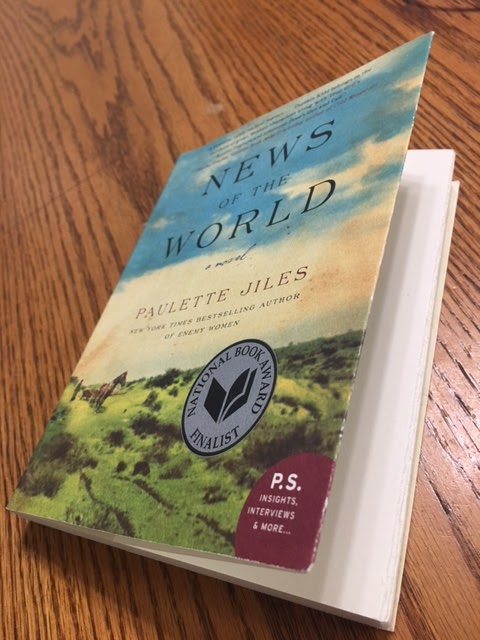
News of the World by Paulette Jiles

News of the World was a book club choice but I missed that meeting and had not read it yet. In fact, I had forgotten all about it or ordering it. A nice surprise when it arrived in the mail!

Once again, I was charmed by the physical aspect of the book. I like the feel of the front of the paperback cover, kind of rough and thick. And I like the rough-cut pages, also a little thick with uneven sides. There's a word for that. I just googled it: deckle-edge. As I started writing about this, I was thinking it's probably kind of strange for me to care and like the physical things of a book like this. But then I thought it's probably not so weird or publishers wouldn't do it, right? So there you go. There are other weird people like me who are fond of books for their feel, their look and even their smell (at least in my case).

News of the World is historical fiction. The main character is Captain Jefferson Kyle Kidd, a 71-year-old man who travels around the U.S. to small Western towns where the people do not hear or read "news of the world." They often are aware, and even contentious about, local politics, but they do not hear of the news of far-away places such as events in lands like India, Ireland, England, even Chicago, and other far-away cities, "THE LATEST NEWS AND ARTICLES FROM THE MAJOR JOURNALS OF THE CIVILIZED WORLD," as Captain Kidd's posters said.

At one reading:
He read about a great windstorm in London that toppled chimney pots (What is a chimney pot? He could see it on their faces.) and then of the new packing plants in Chicago which would take any amount of cattle if they could only get them...The Captain read of the Irish pouring into New York City, ragged crowds from the passenger steamer Aurora, of the railroad driving into the plains of the new state of Nebraska, of another eruption of Popocatepetl near Mexico City. Anything but Texas politics. (p. 89)
Captain Kidd purchases several newspapers at larger towns and finds good articles to include in his readings. He tries to make his readings almost fairy-tale like, taking the listeners out of their ordinary life, to other lands and other peoples. At the readings, he passes a bucket for people to pay a nickel apiece and in that way ekes out enough to make it.

The book is set after the Civil War, in Reconstruction times.  Captain Kidd served in the Civil War and two other wars, the War of 1812 and "President Tyler's war with Mexico." He is a widow with 2 grown daughters who live in San Antonio. Until the war caused him to lose everything, he was a printer. He had his own printing press and shop, and loved being a printer.

The main storyline of the book is the story of Captain Kidd and "Johanna Leonberger, captured at age six four years ago, from Castroville. Down near San Antonio," or as she says, "My name is Cicada. My father's name is Turning Water. My mother's name is Three Spotted. I want to go home." An acquaintance of Kidd's gives him a fifty-dollar gold piece to deliver her back to Castroville. Johanna's parents were killed by the Indians who captured her, but she has an aunt and uncle who have paid to have her returned to them.

The book was a good read for many reasons. The story is exciting, the writing is good, I learned some new things about life during those times, and the subject of captured Native Americans is fascinating. In a note from the author about her research, she wrote:
Anyone interested in the psychology of children captured and adopted by Native American tribes on the frontier should read Scott Zesch's book The Captured. It is excellent. His book documents child captives from the Texas frontier, including his own great-great-uncle, and in each instance gives the background of death and terror these children endured before they were adopted or claimed within the tribe. There has not been a definitive study of the psychological strategies these children adopted in order to survive but one would be welcome. They apparently became Indian in every way and rarely readjusted when returned to their non-native families. They always wished to return to their adoptive families, even when they had been with their Indian families for less than a year.
 In News of the World, you get glimpses of Johanna's thoughts as she is surviving the trauma of being torn at the age of 10 from the only family she knows, in the Kiowa Indian tribe. Mostly, though, you read the thoughts of Captain Kidd, who grows fond of Johanna. He resists in a way, telling himself he's already brought up his daughters and doesn't want to go through that again, but there is no doubt he cares about Johanna and all she is going through. He saves her life and she is also instrumental in saving his.

I found the fact that the author did not use quotation marks for dialogue or thoughts mildly distracting, but I highly recommend this book.

Saturday, April 29, 2017

A Thousand Mornings by Mary Oliver

I bought several books by Mary Oliver today. They are beautiful little books with soft covers that have beautiful pictures on them. With beautiful poems inside in attractive fonts. I like looking at and feeling them. Reading them, too, of course. I kept taking various books out, trying to decide which to get. Then I bought four. That didn't quite work out the way I intended. But anyway.


Here's the first poem in the book A Thousand Mornings by Mary Oliver.

               I Go Down to the Shore
               by Mary Oliver

               I go down to the shore in the morning
               and depending on the hour the waves
               are rolling in or moving out,
               and I say, oh, I am miserable,
               what shall--
               what should I do? and the sea says
               in its lovely voice:
               Excuse me, I have work to do.

This poem makes me smile every time I read it. It reminds me of how God responded when Job said, Why did these terrible things happen to me?

Your thoughts?

Scape by Luci Shaw

I am at Lynden this week. I came for my mom's funeral and then stayed an extra week to help close up accounts and take care of all the things that need to be taken care of after the death of our parents. (My dad died January 27, and Mom April 14).

It's April, which, thanks to Facebook, I know is the month of poetry. I bought several books of poetry at Lynden's bookstore. One was Scape by Luci Shaw, which I thought was extra appropriate since she is a local poet, living in Bellingham I believe. My sister Jan has gone in the past to some literary nights that Luci Shaw has held. I also saw and heard her at The Faith & Writing Festival.

Here is one poem from Scape.

States of Being
by Luci Shaw

Isn't stability greatly over rated?
Why would I ever want to sit
     still and smug as a rock,
     confident, because of my great
     weight, that I will not
     be moved?
Better to be soft as water,
     easily troubled, with
     at least three modes
     of being, able to shape-
     shift, to mirror, to cleanse,
     to drift downstream,
To roar when I encounter the rock.


I like this poem because it seems to describe an aspect of me -- someone not stable -- and it says that is okay, in fact is it overrated, to be stable.

I tend to think of being unstable instead, someone who doesn't say the right things many times, who blurts out tactlessly. I like thinking of it as being "soft as water" instead. And still someone who roars sometimes.

What do you think?

Saturday, April 22, 2017

Silence by Shusaku Endo

I put off reading this book for quite a long time. I was worried it would be too sad and make me depressed. I knew that it was about persecution of Christians and included torture, death, and suffering. But I discovered that I am able to handle these sad events and story parts when I am left with a feeling of hope rather than despair.

Years and years ago, when Randy and I were dating, we used to have dinner and a movie on Fridays. We'd go to the movie theater and just watch something that was there -- no planning. One time we walked into and watched the movie "The Deer Hunter." Wow, that left me in despair. Days later I was on the phone with my mom and dad and Mom said, "Mavis, what's wrong?" She could tell by my voice that I was down.

Silence tells the story of two Jesuit priests from Portugal who go to Japan to find their beloved teacher, Christovao Ferreira, who, "an experienced missionary held in the highest respect," after 33 years in Japan, had apostasized (shown and said that he did not believe in Christ--he was not a Christian). The book takes place during a long period of time in Japan where Christians were persecuted.

The two priests who followed Father Ferreira were Francis Garrpe and Sebastian Rodrigues. They had "vivid memories of their old teacher Ferreira from whom they had learned theology," and asked themselves, "Had that face with its clear blue eyes and soft radiant light--had it been changed by the hands of the Japanese torturers?"

The story of their journey to Japan begins with letters written by Rodrigues. Through those letters, you learn of their harrowing, secret, forbidden trip to Japan and of them meeting their first Japanese person who took the journey with them:
What am I to say about this man, this first Japanese I ever met in my life? Reeling from excess of alcohol, a drunken man staggered into the room. About twenty-eight or nine years of age, he was dressed in rags. His name was Kichijiro. When finally he answered our questions we learned that he was a fisherman from the district of Hizen near Nagasaki. Before the famous Shimabara insurrection he had been adrift on the sea and had been picked up by a Portugese ship. Whether or not it was due to his drunkenness I do not know, but there was a crafty look on his face, and as he spoke he would roll his eyes.
Kichijiro reminded me of Gollum in The Lord of the Rings. He was a betrayer, someone used by the enemy, weak, cowardly, a liar, extremely unlikeable, and yet the missionaries needed him to show them the way, and near the end of the story, he was even an example of God's great love.

A big part of the story in this book is the "fumie." To prove you are not a Christian, you are told to step on the fumie, described as "a board to which was attached an image of the Virgin and child." Christians' faith was tested not only by having to step on the fumie, but they were also betrayed by the way in which they took this step, as when the reaction of the watching officials was described: "What had caught their attention was not the actual fact of the Christians placing their foot on the fumie, but the expressions on their faces as they did so."

Throughout the book runs the theme of God's silence. "Behind the depressing silence of this sea, the silence of God...the feeling that while men raise their voices in anguish God remains with folded arms, silent." That silence causes a crisis of faith for Rodriguez.
No, no! I shook my head. If God does not exist, how can man endure the monotony of the sea and its cruel lack of emotions? (But supposing...of course, supposing, I mean.) From the deepest core of my being yet another voice made itself heard in a whisper. Supposing God does not exist...
Rodriguez does not answer his own question, nor does God. Rodriguez just keeps going. As Christians are martyred because the officials find out he is with them, as he sees entire villages wiped out because of their Christian faith, he continues. In a way, this reminded me of Job. But in the story of Job, God speaks. He practically yells at Job when Job asks why me. God says over and over, "Where were you when I..." God doesn't answer Job, but he is not silent. In this book, there is no voice of God in response to Rodriguez. Just silence.

Another question troubles Rodriguez in this book. He wrote:
And there arose in my mind that terribly dramatic scene at the Supper when Christ turned to Judas with the words, "What thou dost, do quickly." Priest though I am, I find it difficult to grasp the full meaning of these words...What emotion had filled the breast of Christ when he ordered away the man who was to betray him for thirty pieces of silver? Was it anger? or resentment? Or did these words arise from his love? If it was anger, then at this instant Christ excluded from salvation this man alone of all the men in the world; and then Our Lord allowed one man to fall into eternal damnation.
Kichijiro acts as Judas for Rodriguez. Kichijiro betrays Rodriguez to the government officials.

As the story continues, Rodriguez is not asked to apostatize (say and show he is not a Christian) to prevent his own torture and death, but to prevent that from happening to others. This puts a whole new aspect on the question of whether or not to apostatize.

As I read parts of the book again in order to write about it, I noticed that there were a few times where Rodriguez had a vision of Christ's face, Christ's eyes looking into his, once with a tear. I did not remember this. It makes me think of the Jesus looking across the courtyard to Peter when Peter denied him the third time. I've always pictured the face of Jesus at that time filled with love and sorrow.

I will write about the conclusion of Rodriguez' story, so you are warned that this is a spoiler. I am writing more to think through the story than to rate or recommend it, although I do that as well.

After much time in prison, Rodriguez finally meets his beloved teacher Father Ferreira. Ferreira has turned away from his faith and is now working for the Japanese government himself. He has taken a wife and children, and a new name. He is writing about astronomy, which is something he seems proud to be able to do as a contribution to the Japanese people. He is also writing about why Christianity does not work in Japan. He speaks at length to Rodriguez about that. 

He tells Rodriguez that the Japanese never did believe in the Christian God, even during the wonderful period that Rodriguez has heard of, and that Ferreira was present for, when the priests were loved, there were thousands of Christian believers, and the faith flourished in Japan. Even then, Ferreira says, "They did not believe in the Christian God...The Japanese till this day have never had the concept of God and they never will...The Japanese cannot think of an existence that transcends the human...The Japanese imagine a beautiful, exalted man--and this they call God."

He tells Rodriguez, "This country is a swamp...a more terrible swamp than you can imagine. Whenever you plant a sapling in this swamp the roots begin to rot; the leaves grow yellow and wither. And we have planted the sapling of Christianity in this swamp."
Ferreira repeats words like these and more when he talks again to Rodriguez in his final imprisonment. Rodriguez hears what he thinks is snoring but is told that it actually is the moaning of Christians being hung over the pit. One of the dastardly tortures for Christians is to tie them up and hang them upside down over a pit. Slits are cut behind their ears to allow blood to escape from the pressure. It's a horrible, slow, painful death. Rodriguez asks why they do not apostatize and he's told they have, but they will not be set free unless Rodriguez steps on the fumie. 

Rodriguez is in agony while facing this decision. Ferreira brings up the question of what would Jesus do in this situation, how would he show his love. "Now you are going to perform the most painful act of love that has ever been performed," said Ferreira. Rodriguez thinks of that face of Christ he has seen before him. Now he is looking at Christ's face on the fumie. As he lifts his foot, "the Christ in the bronze speaks to the priest: 'Trample! Trample! I more than anyone know of the pain in your foot. Trample! It was to be trampled on by men that I was born into this world. It was to share men's pain that I carried my cross.'"

"It was to be trampled on by men that I was born into this world."

There was a final scene, too, with Kichijiro. Kichijiro asks Father Rodriguz, now called Okad San'emon, to hear his confession and give him absolution. Rodriguez talks to Jesus:
"Lord, I resented your silence."
"I was not silent. I suffered beside you."
"But you told Judas to go away: What thou dost do quickly. What happened to Judas?"
"I did not say that. Just as I told you to step on the plaque, so I told Judas to do what he was going to do. For Judas was in anguish as you are now"
Rodriguez then gives Kichijiro absolution, and he feels he is not betraying his Lord, even though he knows that his fellow priests would think so, since he performed a sacrament only a priests can administer. But Rodriguez thinks, "He loved him now in a different way from before. Everything that had taken place until now had been necessary to bring him to this love. 'Even now I am the last priest in this land. But Our Lord was not silent. Even if he had been silent, my life until this day would have spoken of him.'"

Wonderful video about Silence, Philip Yancey and Mako Fujimura in discussion.

Sunday, April 16, 2017

Hallelujah Anyway by Anne Lamott

I read this book just before my mother died, shortly after my father died. I felt like it was very good timing. I love Anne Lamott. Her books Traveling Mercies, Plan B, Grace (Eventually), Stitches, Small Victories and Help Thanks Why are some of my favorites.

It's been a while since I've read those books, but it seems like one difference between them and this is that Hallelujah Anyway has less stories or vignettes, and more where Anne is talking about mercy or life, without necessarily telling a story.

This review speaks a little to that. At first, I wasn't so sure I was liking this book as much as her others because of that. I often think I am "all about the story" when I read. But as I read and re-read this book, I appreciated it more and more.

The title comes from a gospel song that Lamott quotes as "'hallelujah anyway.' Hallelujah that in spite of it all, there is love, there is singing, nature, laughing, mercy." That feels true to me. In spite of the death of my dad, followed by the death of my mom 2 months later, and the death of my young cousin in what seems like the beginning of the prime of his life, and the pending death of a friend's son at the age of 11. In spite of all that, hallelujah anyway.

The subtitle of the book is "Rediscovering Mercy." She draws her theme from Micah 6:8 "What does the Lord require of you? To act justly and to love mercy and to walk humbly with your God." Lamott says, "Oh is that all?" and calls herself and her friends "Arrogance R Us" when she says that walking humbly "isn't going to happen anytime soon." See what I mean? Don't you love it? She also writes, "We think that if our values aren't the correct ones, we would have other ones, which would then be the correct ones." Ha ha. But of course.

And more. "We know mercy is always our salvation...But I wish it was something else. I wish it was being able to figure things out, at which I am very good, or to assign blame, at which I am better, or to convince people of the rightness of my ideas." Yes, wouldn't it be nice if that were true? If God and everyone else valued my figuring-out and blame-assigning and rightness-convincing skills, life would be so much easier!

I love her thoughts on schadenfreude (I love that word, too!).
But some days the only thing that can cheer me up is something bad happening to someone I hate, preferably if it went viral and the photo of the person showed hair loss and perhaps the lifelong underuse of sunscreen. My heart still leaps to see this. I often recall The New Yorker cartoon of one dog saying to the other, "It's not enough that we succeed. Cats must also fail." This is the human condition, that in the face of death, cats must lose.
"Mercy means we soften ever so slightly," says Lamott. Maybe that's what I mean when I say my heart feels softer. Sometimes I imagine my heart feeling like a cool, kind of mushy but not drippy and messy thing. Maybe something like softened silly putty? Anyway, I seem to have more sympathy than I used to, less feelings of judgment. I still, as Anne says, feel that I am good at convincing people of my rightness, and often not only that, but others would be much better off if they would just realize my rightness, but somehow even that response is usually softer. Often I am able to feel have a better, more right opinion...and not say it! How about that?!

Lots of Anne's writing makes me laugh. It tickles me. A mis-reading also made me laugh. I read one sentence as "All I have to do in order to begin again is to love mercy, if I am to believe nutty old Mitch." It wasn't Mitch, it was Micah. But for a minute I was picturing good old Mitch, nutty and saintly, kind of like the angel Clarence in "It's a Wonderful Life."

Her turns of phrase are so funny, and often so wise.
"The good news is that God has such low standards."
"Jonah is burped onto dry land..."
"But everyone steps on the cosmic banana peel sooner or later."
"We learned that we were all animals, like monkeys and goats, but with Edward Gorey minds..."
"Raising my son brought me the greatest, happiest years of my life. And it was hard, which somehow people had forgotten to mention would be part of the mix. Oops."
She writes about Peter's denial of Christ in Matthew's Gospel, when Jesus called Peter Satan, and said, "But Luke loved Peter and Photoshpped this part out."
About a room full of "alkies" near Skid Row, "The sober people Tom knew in Berkeley all seemed like David Niven in comparison."
Silence has been a fascination for me recently. There's the book and the movie Silence. I haven't seen the movie yet but I did read the book. The silence in that case is the silence of God. I heard a podcast by a writer who collects silence and talks about it as an "endangered species" that made me want to visit Olympic National Park. Lamott write about silence.
Holy silence is spacious and inviting. You can drink it down. We offer it to ourselves when we work, rest, meditate, bike, read. When we hike by ourselves, we hear a silence still pristine with crunching leaves and birdsong. Silence can be a system of peace, which is mercy, easily offered to a friend needing quiet, harder when the person is one's own annoying self.
I am sure I will re-read this book, as I will Anne Lamott's other books. So much to absorb, to think about, and to laugh with.

Saturday, April 08, 2017

Last Days of Night by Graham Moore

This book is written by the same author who wrote the sreenplay for The Imitation Game, which I thoroughly enjoyed as well. He wrote another book called The Sherlockian that I may read later.
Last Days of Night is a novel that really is a biography of a young lawyer who works for George Westinghouse, and through it meets Thomas Edison and Nikola Tesla, among others. It was interesting to me to learn more about these legendary people. I associate them with things like light bulbs and inventions, but this made them real people.


We read this book in my book club and one of the members pointed out that there is a section in back where the author talks about what parts of the book are true, based on reports from the time, and those where he imagined what scenes were, and places where he either changed the order or combined things that happened at different times, and so on. I was glad to know that. As I read those notes, they seemed to point out that, really, the book is good history - the changes made it a story, a novel, instead of a textbook.

George Westinghouse.jpg
I liked the quotes at the beginning of each chapter. They were often by Bill Gates and Steve Jobs and others of that ilk. It was interesting to read again Thomas Edison's quote "I have not failed. I've just found ten thousand ways that don't work." But one of Tesla's issues with Edison was that when he was working in Edison's lab, they would have to experiment over and over and Tesla found that a waste of time. He felt he could determine if something would or would not work through, I think, exploring it thoroughly in his mind, and he didn't need to do all that actual experimenting.

Image result for thomas edisonThe main character is a lawyer named Paul Cravath. He is based on a real person, too. Paul becomes employed by George Westinghouse pretty much straight out of law school. Westinghouse is suing Edison for the light bulb patent. The courts keep ruling that Edison invented the light bulb and Westinghouse improved it, but Westinghouse believes he truly invented something new, not just an improvement.

There was also a big hullabaloo about DC and AC. I had no idea! Direct current and alternating current were big concepts that had a lot to do with safety and costs and what worked over a distance and therefore what made sense to provide electricity for cities, and from there, everything else. In that fight, the invention of the electric chair was a tool to prove a point. The description of the first use of an electric chair is just horrific. And to think we are still figuring out if that is cruel and unusual punishment or not.

Here's a good passage that helps illustrate how the book is historical and you can learn a lot, yet it's a story, it keeps your interest, and it's characters "acting" to tell the story, not a textbook.
"I am being sued."   [George Westinghouse]
Paul was well aware. In the time since his invitation to dinner, he'd devoured all the newspaper accounts of Westinghouse's legal troubles. The dispute was highly public. "Thomas Edison has sued you for infringing on his patent on the incandescent light bulb."
"Edison's bulbs are terrible--poor-quality designs, two generations behind mine. There are a dozen companies across this country making bulbs of more advanced design than Edison's. Mine just happen to be by far the best."
"Yours are better. But Edison's were first. It's the latter issue that is of legal concern. Your difficulty is that he's the one with the patent."
"I did not copy Edison's design for the light bulb. I improved upon it. Tremendously. My light bulb is to his as a motor wagon is to a horse-drawn carriage. Would there be justice in forbidding Mr. Benz from selling the former because of the existence of the latter? Of course not. Edison is not suing me--he is suing progress itself because he lacks the ability to invent it."
"It sounds," suggested Paul, "as if you're in need of a very good attorney."
This book is a good story. Even if you, like me, have no special interest in learning about electricity, Thomas Edison, or Westinghouse, you'll enjoy the book for the story. Good writing, good plot, good characters.

Saturday, July 16, 2016

Ordinary Grace by William Kent Krueger

Ordinary Grace was a good story from the Prologue to the Epilogue. The first sentence of the Prologue is, "All the dying that summer began with the death of a child, a boy with golden hair and thick glasses, killed on the railroad tracks outside New Bremen, Minnesota, sliced into pieces by a thousand tons of steel speeding across the prairie toward South Dakota."

The second paragraph of the Prologue begins, "It was a summer in which death, in visitation, assumed many forms. Accident. Nature. Suicide. Murder. You might think I remember that seems tragic and I do but not completely so."

So the book is the story of that summer. The narrator is Frank, the son of a Methodist preacher in the small town of New Bremen. He has a younger brother Jake and an older sister Ariel. It's set in the year 1961. The way the story is told, or maybe the way it felt as I read it, reminded me of To Kill a Mockingbird and also A Prayer for Owen Meany. And Gilead. A small town, several decades ago, and a family going through a seemingly ordinary time, but full of significance.

I loved the turns of phrases in conversations. In an early conversation between Frank and Jake, Jake wants to go along with Frank and Frank says, "Like hell." Jake: "You said hell." So simple, but I can just hear them saying it. And I felt like I was right there, in New Bremen. I could see the roads, the houses, the paths by the river, the woods, the trestle bridge, the river.

This was one of the most skillful uses of foreshadowing I've seen. Sometimes foreshadowing bugs me. It almost seems like a spoiler. Or I'm frustrated and think, "Stop hinting around and get to the story already." But that didn't happen in this book. Those 2 first sentences I quoted above had foreshadowing, right out of the gate. In this case, those hints made me want to keep reading.

At the beginning of this blog entry I thought about writing that the book is compelling, but I didn't want to make it sound like some kind of suspenseful mystery or something. Yet it is compelling. It was a good story, and I wanted to see what would happen. It was one of those books where I stayed up much of one night just to keep reading.

I think the foreshadowing was effective because I was more than content to stay in the story where I was. I didn't want to rush to find out what would happen next because I was happy right where I was, in whatever part of the story I read one of those hints about what was to come.

Frank is a kid who wants to be good but who also is filled with curiosity and eager to know everything there is to know. When his father gets called to situations, Frank always wants to go along. His brother Jake wants to go with Frank anywhere he goes. Sometimes -- often -- Frank's curiosity and wanting to know everything doesn't make him happier. But it definitely makes the story better.

Jake has a stutter. Kids make fun of him for it, and even though Frank sticks up for Jake over and over, Frank, when he wants to rile up Jake, sometimes mocks his stuttering. Because of his stuttering, Jake doesn't speak much, but he sees and understands much, often surprising Frank with insights Frank himself never would have noticed.

You get to know everyone in the family and they all have interesting personalities. Probably one reason the book reminded me of To Kill a Mockingbird is because the father, Nathan Drum, like Atticus, is a respected, honest, wise man of few words. The characters in the book love him, and you know he loves them.

Ariel, Frank's older sister, is in high school and looking ahead to going to Julliard to develop her musical talent. She plays piano and sings, and has inherited that talent from her mother, Ruth. Beyond the family, there are several other important characters you get to know and love.

I highly recommend this book. Good story, great characters, gives you food for thought, too. Kirkus review said, "A novel that transforms narrator and reader alike," and I would agree.


Saturday, March 05, 2016

Last Bus to Wisdom by Ivan Doig

Last Bus to Wisdom was a fun book to read. In a previous post I mentioned reading another book by Ivan Doig, The Bartender's Tale, and that one was fun, too. I plan to read more by Doig.

In this book, the hero of the story is Donal ("Donny") Cameron, 11 years old. His parents have died and Donny lives in Montana with his Grandma. She has to have surgery so Donny is sent to her sister Kate in Wisconsin. Donny travels there in a Greyhound bus (they call it "the dog bus").

He does not like staying with Kate. She is a crabby, selfish, rather mean lady. Donny does like her partner "Herman the German." After a few adventures and mishaps, Kate sends Donal back to his grandma, back on the dog bus. It turns out Herman joins him, leaving Kate. Donal and Herman go on a great journey with lots of adventure and wonderful characters they meet while traveling.

They end up with a group of hoboes near a town named Wisdom on a ranch owned by a rodeo broncing buck rider named "Rags." There's a satisfying happy ending. I highly recommend this book and any by Ivan Doig.

Outlander by Diana Gabaldon

I enjoyed Outlander. I didn't really know much about it when I started so I was not at all sure what I was getting into. I had heard of the TV show based on the series of books, but I knew nothing of what the story was or anything.

This first book of the series starts with a nurse who has returned from World War II, Claire, and is on a vacation with her husband. She goes to a kind of mini-Stonehenge and suddenly falls through the rock somehow and ends up in Scotland in the 18th century. She ends up with a Scottish man named James.

I enjoyed the book. It's a good, gripping story, and you really get the feeling you're in another world. It was more of a "bodice ripper" than I had expected. Nothing vulgar or even "hot and heavy" or at all embarrassing, but a bit more detailed about Claire and James' love life that I expected.

As everyone probably knows, this is the first of a series of books and it is a series on TV as well. I will try to see at least some episodes of the show. I haven't decided yet if I'll read more of the series. Right now my to-be-read pile is very high, so I'll wait at least a while.

The Eliot Family Trilogy - The Bird in the Tree, Pilgrim’s Inn, and The Heart of the Family - by Elizabeth Goudge

I loved all 3 of these books. If you like British literature or are an Anglophile like me, you'll love these, too, and I'm sure anything by Goudge. They are all about the Eliot family, starting with the matriarch, Lucilla. As I'm thinking about these books, I just realized they remind me of the movie "Enchanted April."

Place plays a big role in these books -- two country houses where the family lives. You grow to love those places in the same way you love the characters. 

Here, in my sister's blog, she talks a little bit about Elizabeth Goudge.

Besides the homes, Goudge writes a lot about the woods nearby. I usually find it hard to read every word of descriptions of landscapes. I often skim them. But in these books, kind of like the homes, the woods become important, too, and I had no problem at all reading every word and picturing those woods.

I don't want to call it "supernatural," but there's a little bit of sixth sense, or maybe spirituality, or a kind of magic, maybe a sense of God's presence, in the books. There's a place in the woods where it is hinted that the children seem to meet a long-ago inhabitant who helped to heal the animals. There's some kind of spirit to the houses, perhaps also from a long ago inhabitant of the homes. There are times where the characters seem let to actions or places by a force beyond them.

This force, or whatever you may want to call it, felt good to me. I was glad to read about it and feel it. That's not always true for me. Sometimes that kind of thing causes fear or a spooky feeling, which happened in the one book by Isabel Allende that I read. I might call it a little Narnian but I wouldn't want you to think the books are fantasy or science fiction. Not at all.

The stories are excellent. Here is a good review, where the writer summarizes what they are about. I highly recommend these books. 


Saturday, December 26, 2015

Our Souls at Night by Kent Haruf

Kent Haruf is one my favorite writers. His books are such good stories. The first book of his I read was Plainsong and then its sequel Eventide. I still think those are the best of the lot. I believe I've read all his novels, and I hope he'll write more so I can keep reading them all.

Our Souls at Night is, like all his novels, set in the small town of Holt, Colorado. In this story, a 70-year-old woman, a widow, Addie Moore, asks her neighbor, a widower, Louis Waters, to sleep with her. Sex is not necessary; it's a matter of relieving the loneliness, and nights are the worst.

Both Addie and Louis (persuaded by Addie) decide they don't need to care what people think anymore. Louis openly walks over the Addie's house in the evenings. They enjoy the companionship of sleeping in the same bed and their lives become more engaging by getting to know each other's life stories. Both the characters are people I enjoyed getting to know.

Haruf does not tie everything up in happy endings. I wouldn't call his endings sad or at all depressing, but they feel real. In this book, too, the good thing that Addie and Kent have going is messed up by Addie's grown son. At the same time, the interaction between her son's son and both Addie and Louis is a highlight of the book. So there's good and bad that happens as a result of the connection between Addie and her son.

I highly, highly recommend Our Souls at Night and all of Haruf's novels.

After You by Jojo Moyes

I heard that the sequel to Me Before You was even better than the first. I did enjoy it just as much.

The book picks up when Louisa is working as a waitress again, after her travels that began at the end of the other book. She enjoys waitressing -- which is hard for me to imagine since I am, I believe, pretty much the worst waitress in the world. I'm too forgetful.

It continues with Louisa trying to figure out what to do next in her life. She liked traveling but after a while decided she had had enough of that. She starts going to a grief therapy group and those people become her friends. Also through one of them she meets a new man who becomes an important part of her life. Her parents go through a crisis but they also grow close to her again through a close call that Louisa goes through. And Louisa meets a daughter of her previous love who neither he nor anyone else knew about it. This leads to more connections with his family.

So, as you can tell, it's an eventful book. It kept me turning the pages. I was interested in what Louisa would do and her thought process for making decisions about what direction to go. Besides being event-filled, Moyers writes with some humor as well. I definitely recommend both these books.

Friday, December 18, 2015

Felicity by Mary Oliver

I have just started reading this book of poetry by Mary Oliver. It's wonderful. Here's one for you to enjoy, and I have a few questions, too, you can weigh in on.
Roses
by Mary Oliver

Everyone now and again wonders about
those questions that have no ready
answers: first cause, God's existence,
what happens when the curtain goes
down and nothing stops it, not kissing,
not going to the mall, not the Super
Bowl.

 "Wild roses," I said to them one morning.
"Do you have the answers? And if you do,
would you tell me?"

The roses laughed softly. "Forgive us,"
they said. "But as you can see, we are
just now entirely busy being roses."

I love the image of the wild roses, of them laughing and talking. Their answer is so good - "entirely busy being roses."

There's one part that I don't understand. Where it says "what happens when the curtain goes / down and nothing stops it, not kissing, / not going to the mall, not the Super / Bowl." I think that the part about the curtain going down is one in the list of "questions that have no ready answer," like "first cause" and "God's existence." Then it seems like the phrases about not kissing and the mall and Super Bowl would be things that don't stop the curtain from going down.

But that's what I don't get. What do those actions (kissing, going to the mall and the Super Bowl) have to do with stopping the curtain going down, with stopping one of the hard questions to answer?

Maybe she's saying actions of that kind don't stop life from continuing on to death (death being the curtain going down)? Not understanding doesn't take away how much I like this poem, but it does make me curious.

Any thoughts?

Sunday, November 29, 2015

Me Before You by Jojo Moyes

I'm not exactly sure why I liked this book so much, but I did. I read it almost in one setting. You could call it predictable; The end was not a surprise by any means. And maybe you could even call it a little schmaltzy, since it's a love story that makes you cry.

Somehow, though, I did like it a lot. It's the story of a young woman in Great Britain who loses her job, then is hired as a caretaker/companion for a rich young man, Will, who is a paraplegic.

The main character is the young woman, Louisa. It is written in first person, from her point of view. But there are a few parts where the first person is one of the other characters.

One reason I liked the book is I liked Louisa. I liked listening to her narration. She has a good sense of humor and she feels like a person who I would like to know. 

A big part of the book is that Will wants to die. I hesitate to even write that because it makes the book sound maudlin. It did make me cry, but it didn't feel like a tear-jerker to me. I felt like I learned more about what it feels like to be a paraplegic like Will. Of course there's no way to really understand, but there were definitely insights I had never thought of.

I liked all the characters in the book. I see there is a sequel and others who have read it say they liked the sequel, too, some even better than the first. I plan to read it, too.

Sunday, November 22, 2015

The Arsonist by Sue Miller

The Arsonist was recommended to me by "the librarian", my friend at Sinaloa Cafe where we go for Mexican dinner nearly every Friday. Way back years ago when I met her it was because she was reading a book while we were waiting for a table. I asked her what she was reading, and that started a friendship that includes exchanging book recommendations nearly every time we see each other.

Aileen was a librarian at a school when I met her. She and her husband are retired now. We don't see them every Friday, but they are regulars at Sinaloa, just as we are.

This Friday Aileen recommended The Arsonist and You Before Me. I ordered both of them and started with The Arsonist, which I finished yesterday.

When I read the summary on the back of the book, I thought it would be a mystery. That's why I chose to read it first, because I enjoy mysteries. I would not call it a mystery, though. There definitely is a mystery involved -- who is the arsonist -- but even though the fact that there are fires set by an arsonist as a central part of the book, the story is not about figuring out who is setting the fires.

The story is set in "a New Hampshire village" (says the synopsis on the back of the book), Winslow. The main character is Frankie Rowley, whose family has a summer home there, and where now her parents are living year round. Frankie is in her forties, single, and has a career as an aid worker in Africa. When she goes back to Winslow at the beginning of the book, she is not sure whether she'll go back to Africa or not, nor is she sure of what she will do at all.

I hesitated to write "the main character" because two other characters are featured prominently and the author reveals their thoughts and feelings, in the same way she does Frankie's. One of these is Frankie's mother, Sylvia, and the other is her romantic interest in the story, the town's newspaper editor, Bud. Frankie is the main character, but I feel like Bud is a close second, and Sylvia is in third place.

I like the writing, and I thought the story was compelling -- I wanted to keep turning the pages and find out what was going to happen. It's set in nearly present time, but not quite. There are no cell phones, but there are pagers. Some of the sources of uncertainty, making you want to keep reading, are the growth of Bud and Frankie's relationship, her growing awareness of her father's dwindling mental capacities, her mother's feelings toward her husband (Frankie's father), the differences of the town "year-rounders" vs. the summer people, and, of course, the mystery of the fires.

All in all, I recommend the book as a good read. I wouldn't consider it a contender to be a favorite, but I enjoyed it and I could even see myself re-reading it at some point in the future.

Friday, July 24, 2015

Delicious Sentences

I have a friend who posted this on Facebook:
"She enjoyed registering her fellow citizens' neuroses, intimacies, and habits, plotting them on a scale of decency, and knowledgeably passing on her opinions to others. She was generous in that regard." Nina George, The Little Paris Bookshop.
What delicious sentences.
I thought about what my friend had written as I was re-reading Jane and Prudence by Barbara Pym. It is full of delicious sentences. Some examples below:
"But I've never thought of myself as caring for canons," said Jane rather wildly.
"What are we having for supper?" asked her husband.
"Flora is in the kitchen unpacking some of the china. We could open a tin," added Jane, as if this were a most unusual procedure, which it most certainly was not.
"I suppose old atheists seem less wicked and dangerous than young ones," said Jane. "One feels that there is something of the ancient Greece in them."
Father Lomax, who evidently thought no such thing, let the subject drop.
Jane often thinks or says things "wildly." Little comments like "as if this were a most unusual procedure, which it most certainly was not" and "who evidently thought no such thing." Delicious.

Monday, June 29, 2015

Between You and Me by Mary Norris

I just started this book but I want to write out a quote already. Mary Norris calls herself a "comma queen" at the New Yorker. She checks the grammar and other aspects of stories in the magazine.

In this quote Norris is talking about autocorrect, and it made me laugh out loud.
Autocorrect I could do without. It thinks I am stupid and clumsy, and while it's true that I don't know how to disable it and I can't text with my thumbs like a teenager (though I am prehensile), why would I let a machine tell me what I want to say? I text someone "Good night" in German, and instead of "Gute Nacht" I send "Cute Nachos." I type "adverbial," and it comes out "adrenal," which is like a knife thrust to my adverbial gland. Invited to dinner, I text my friend to ask whether I can bring anything, and she replies that the "food and dissertation" are under control. Good news, I guess. I understand to bring wine and not ask anyone the topic of his PhD thesis.

Friday, May 29, 2015

Fiction is fun

It's turned out to be quite a long time since I've read a novel (a new one; I've been doing a lot of re-reading lately). I kind of forgot how fun it is to read a really good story, and just enjoy the story.

Yesterday I finished A Dangerous Place, by Jacqueline Winspear, the latest of the "Maisie Dobbs" novels she writes. It was great, as have been all the others.

Today I started reading The Bartender's Tale by Ivan Doig. I am enjoying it so much! I've only just started but loving it so far. I was lying in bed this morning thinking over what I've read so far and wondering about what will happen next. I haven't done that in a while, either. It's been a pretty happy, kid-growing-up kind of story so far and I was lying there thinking that eventually probably something bad or sad will happen. There has to be a climax coming at some point, right?

Anyway, I'm having fun. I recommend both books. I'll try to come back and blog more thoroughly about them later.

Saturday, May 02, 2015

Georgette Heyer Makes Me Laugh

This is one of the reasons I love reading books by Georgette Heyer: They make me laugh.

Today I am re-reading Faro's Daughter. Who knows how often I've read it already? I keep these books on a shelf by my bed and grab them to read over and over.

A passage I just read made me laugh aloud. The main character, Deb Grantham, and her aunt, Lady Bellingham, are hiding Phoebe Laxton, a young, rather foolish woman, in their home. Phoebe has just been discovered by her persecutor and is so frightened at being seen that she faints when she runs to tell Deb and Lady Bellingham. They succeed in waking her and try to find out what happened to scare her so.

First there is the passage where Phoebe faints and Lady Bellingham is trying to figure out how to revive her:
'Oh, heavens, if it is not one thing it is another!' wailed her ladyship, looking round wildly for the vinaigrette. 'Untie her laces! Where are those salts? Why is nothing ever where it is wanted? Ring the bell! Oh no, the hartshorn is in that cupboard! I shall go distracted! You ought to burn some feathers under her nose, but there are only the new ostrich plumes in my best hat, and really---- However, take them if you like! I am sure I do not grudge them!'
I must admit I snorted as I wrote this. Not very ladylike, I know, but it cracks me up. Barbara Pym also uses "wildly" in this way. Her characters sometimes speak or think "wildly" like Lady Bellingham does here. And I love the way her ladyship is willing to sacrifice her ostrich feathers. Too funny.

The book goes on to describe Deb and Lady Bellingham's unsuccessful attempts to calm Phoebe down with reason and reassurances. They are quite frustrated that nothing they say makes any difference. Then Phoebe's fiance, Lord Mablethorpe, comes in and learns of the problem.
...his brows drew together across the bridge of his beautiful nose, and he said with more decision than Deborah had ever before heard in his voice: 'That settles it, then!'
    Miss Laxton [Phoebe] heaved a huge sigh, and tucked her hand in his. 'I knew you would know what to do!'
    'Well, it's to be hoped he does,' said Lady Bellingham, with some asperity. 'If I had known that all you wanted was to hear someone say that settles it, I would have said it myself for I am sure it is easy enough to say, and doesn't signify in the least!'
I find that quite hilarious. "Asperity" itself is just a funny word. And the absurdity that if her ladyship -- or anyone -- had just said that settles it, all would have been well.

I only know a few other people who love Georgette Heyer novels like I do. My best friend from high school, Cindy B, was the one who discovered them and told me about them; my sister Jan shares my enjoyment; my good friend Gert Bamford also was one of the rare people who not only had heard of Georgette Heyer but, like me, often tested the worthiness of used bookstores by checking to see if they carried Georgette Heyers.

One time when I was sad and scared about some health tribulations going on, my sister was trying to comfort me on the phone. She said, "I wish there was something I could do to help, Mave." I asked her to bring over some of the Georgette Heyer books she owned. Jan said she would bring them all and, "You be the keeper of our Georgette Heyer books." It makes me tear up to think about. What sisterly love.


Links:
On Georgette Heyer
Georgette-Heyer.com
Wikipedia
Amazon author page


Saturday, April 18, 2015

Searching for Sunday by Rachel Held Evans

I loved this book! I love Rachel Held Evans so I had pre-ordered it when Held-Evans announced it was coming. It's full of memorable statements like the one below.

The book is divided into 7 sections, for 7 sacraments: Baptism, Confesion, Holy Orders, Communion, Confirmation, Anointing of the Sick, and Marriage.

In the prologue, Rachel talks of how "religious folk have always had it out for us night owls." I am not a night owl myself, but my daughter is and I thought of her as I read, "'...At the break of light it [the Church] rememebers the morning on which death and sin lay prostrated in defeat and new life and salvation were given to mankind.' This comes as unfortunate news for someone like me who can barely remember who she is at the 'break of light,' much less ponder the theological implications of the resurrection...No doubt I would have shooed poor Mary Magdalene away with a soft, pillow-muffled grunt had she asked me to help her bring the burial spices to the tomb that fateful morning two thousand years ago. I'd have slept right through the Main Event."

Later, still in the prologue, she writes about some reasons she feels people are leaving the church: "We don't want to choose between science and religion and between our intellectual integrit and our faith...When our gay, lesbian, bisexual, and transgender friends aren't welcome at the table, then we don't feel welcome either..."

My own theory about why people aren't coming to church goes beyond what the church has or has not to offer. That's definitely a factor. But I feel, actually it's more practical than that -- they don't feel like setting the alarm on a weekend day and having to get up, get dressed, and go somewhere. But that's a whole different subject I won't go into right now.

The subtitle of this book is "loving, leaving, and finding the church." A big part of Held Evans' life story is that she grew up in an evangelistic church her father pastored, was very gung-ho, excelling in the Biblical pursuits espoused by the church, and believing wholeheartedly everything taught there. Then as she grew older and started being exposed through books and life to many other types of beliefs and conflicting values, she started to wonder and doubt about the teachings of the evangelistic church.

This book talks of leaving the evangelical tradition and looking for a church she felt better matched her beliefs, yet also coming to terms with the evangelical church that is her heritage, and even realizing she loved that history and needed it.

A great quote from the baptism chapter: "The good news is you are a beloved child of God; the bad news is you don't get to choose your siblings." So funny because it's so true.

Held Evans talks in this chapter about the feeling that you are not fit for church membership until you've conquered your "demons" -- the sin in your hearts. She writes: "demons are as real as the competing identities that seek to possess us. But rather than casting them out of our churches, we tend to invite them in, where they tell us we'll be children of God when
  •  we beat the addiction.
  • we sign the doctrinal statement
  • we help with the children's ministry
  • we get our act together.
  • we tithe.
  • we play by the rules.
  • we believe without doubt.
  • we are married. 
  • we are straight.
  • we are religious.
  • we are good."
I had not thought of sin or demons that way. I know there is sin in the world and in our hearts. I just hadn't thought of them in such a concrete way, as devils or demons.

And, "...sometimes I think what the church needs most is to recover some of its weird...In the ritual of baptism, our ancestors acted out the bizarre truth of the Christian identity: We are people who stand totally exposed before evil and death and declare them powerless against love. There's nothing normal about that."

Rachel writes about doubt coming in to her life, "like an invasive species, like kudzu trellising the bran: What if none of this is true? What if it's all one big lie?"  I can related to this kind of doubt. Over the years I would periodically go into a kind of season of doubt. Now, though, I am usually successful in avoiding those seasons. I was in a doubting season when I heard that my brother had ALS. I decided then that I did not want to think any more about doubt; that I would believe like a child. It was and is basically mind control. When those kinds of thoughts start sneaking into my brain, I start thinking about other things. For this situation, I usually start thinking about my blessings and all the things I believe without doubt. 

In another place in this book, Held Evans says, "people bond more deeply over shared brokenness than they do over shared beliefs." That struck me as true. It is in her chapter nine, called "Dirty Laundry." I know we shouldn't try to present a perfect church face to the world, however there definitely have been times where I felt that, even if I was inclined to invite someone to my church, I could not do it because I was too afraid they'd find out my church (at that time) did not let women be elders or ministers, or I had a fear that my minister (at that time) might say something I was ashamed of and that would be offensive. Yet I get the sentiment that Rachel wrote, "I've heard many recovering alcoholics say they've never found a church quite like Alcoholics Anonymous. They've never found a community of people so honest with one another about their pain, so united in their shared brokenness." How do we strike a balance between not airing our diry laundry and being that shared-brokenness-community of love to each other?

I love this phrase, too, "broken and beloved."

This blog entry is about just the beginning of the book. It's chock full of more and deeper thoughts, as well as interesting, funny stories. I highly, highly recommend it.


Friday, February 20, 2015

The Innovators by Walter Isaacson

Can you imagine this woman, Ada Lovelace, the daughter of Lord Byron, is the first person featured in this history of technology - the internet and computers? I read about Lord Byron in the Georgette Heyer Regency novels that I love. He was a famous, romantic novelist. In this book, The Innovators, it sounds as if he married for money and the marriage did not last long. Ada's mother must have disliked Bryon a lot because she had Ada tutored in Math in order to "counteract" any tendencies Ada might have to poetry.

It turned out Ada had a love for the poetry of mathematics and science. I did not know this but it turns out that Steve Jobs always featured an image of the intersection of technology and liberal arts when he gave demos of new products. The book had this intersection as a theme, writing about the many different people who exemplified that intersection, and who built on each others' ideas to develop computers, networking and the internet.

Walter Isaacson wrote a biography of Steve Jobs that was a bestseller, and that I also read. It was great. I was thinking at first to describe The Innovators as a bunch of short biographies. But really, it's a biography of technology.

One of the things that surprised me as I read it was the communal aspect of the technology world. When they said, "Power to the people," they meant it. Or many of them did. Many of the creators and inventors who were a part of the development of technology strongly believed in NOT having a central authority that determined rules and so on. They believed in spreading the control throughout the system, with no one person or entity in charge. There was even an early technology company called "The Love and Grace Company."

The structure of the internet is kind of like a fishnet, with multiple paths from one thing to another. There's a piece of equipment in our server room, and millions of other server rooms, called a "router" because that's truly what it is. It routes the data from place to place. And if one router goes down, the data is routed around it.

I was also surprised by the women featured in the book, who were integral parts of the growth of technology. There were a team of women who did the programming of the huge, early computers. They configured the pathways and plugged the cables in and out to program the computers manually. They were usually very much unacknowledged, but they still loved their work.

There's a story of the "mother of all demos" that early inventors had in order to show others the power of computers. It is mentioned not only in the history itself, as an event and what happened, but often referred to by people who attended it as being a big influence for them. For this demo, 4 women did the programming and worked 24x7. The book recounts how the night before the demo they were all exhausted and even though there was still an unsolved problem, they had to go home and go to bed. One woman woke up at 4am with the solution in her head and she went over to the room at that wee hour in the morning to put in the fix.

But these women were not even invited to the demo. There was a big dinner afterward to celebrate and the women were not included. As the men went off to their dinner, the women walked to their hotels in the cold. Sheesh. However, one of those women was in the Navy, became a brigadier general, and had the longest career of anyone in the Navy.

With my work being in the technology arena, it's not surprising I found the book interesting. But I think people not even as geeky as I am would enjoy it, too. It's about people and how they worked together and alone, how they built on each others' ideas, how ideas came to them, how technology involved, the culture surrounding them -- so much more than just how computers were invented.

I highly recommend it.